Why Treating MCAS Without Treating SIBO Fails
Apr 23, 2026You've been managing MCAS for a while. You know your triggers. You're careful with histamine. But you still have bad weeks that don't make sense.
You've ruled out the obvious foods. The supplements help sometimes. Your gut still acts up, and the flares keep coming back.
What if the problem isn't just your mast cells? What if it's what's feeding them?
The Flares That Don't Make Sense
When you've been managing MCAS for a while, you get good at pattern recognition.
Certain foods, certain stress loads, certain environments. You know what tends to set things off. So it's particularly frustrating when the flares come anyway.
This is one of the more common situations I see: someone doing everything right, still reacting. And more often than not, the gut hasn't been looked at closely enough.
Specifically, small intestinal bacterial overgrowth, SIBO, is present in nearly one-third of people with MCAS. That's not a coincidence. It's a mechanism.
What MCAS Does to Your Gut
Mast cells aren't just in your skin and sinuses. They line your entire GI tract. And when they activate, they don't just create symptoms. They release mediators that directly slow your digestive system down.
Histamine, tryptase, and prostaglandins all interfere with something called the migrating motor complex (MMC).
The MMC is the rhythmic, wave-like contraction your small intestine uses to sweep bacteria downstream. It runs roughly every 90 minutes in a fasted state.
Think of it as the cleaning crew that runs between meals. When mast cell mediators suppress it, the cleaning crew stops showing up.
How SIBO Takes Hold
The small intestine is a transit zone, not a residence. It's designed to move bacteria through quickly, not host them. But when motility slows, bacteria from the large intestine can migrate upstream and establish themselves where they don't belong.
That's SIBO. And the type of bacteria that overgrow matters. Gram-negative bacterial overgrowth produces a compound called lipopolysaccharide (LPS), which is released directly into the gut wall whenever these bacteria replicate or die off.
LPS doesn't stay local. It triggers an immune response. And your mast cells are listening.
How SIBO Makes MCAS Worse
LPS is one of the most potent mast cell activators known. It binds to toll-like receptors on mast cells and triggers degranulation. That means more histamine, more tryptase, more prostaglandins. All the things that were already driving your symptoms.
On top of that, many of the bacteria in a SIBO environment produce histamine directly. Species like Klebsiella, Proteus, and certain Clostridium strains are high histamine producers. So now you're dealing with both a bacterial immune reaction and a direct chemical load at the same time.
The loop looks like this: mast cell mediators slow the gut, bacteria accumulate, LPS activates more mast cells, mast cells slow the gut further.
Breaking only one side of that loop is why so many MCAS protocols produce partial results and then plateau.
The Data That Should Change Your Protocol
A 2023 study found that SIBO is present in 30.9% of MCAS patients, compared to just 10% in controls. That's roughly a threefold increase.
More important: when SIBO was treated in MCAS patients, 67.6% experienced marked symptom improvement. That's a stronger response than most MCAS-specific interventions produce on their own.
This isn't niche research. It's directly actionable. And yet most MCAS protocols, even thorough ones, don't include routine SIBO screening. If you've been doing everything right and still reacting, this is the question worth asking.
Is SIBO Part of Your Picture?
The symptom overlap between MCAS and SIBO is real, which makes this tricky to sort out on symptoms alone. But a few patterns are worth paying attention to.
SIBO is more likely to be a factor if you experience:
- Significant bloating after meals, particularly in the hours after eating
- Early fullness that feels out of proportion to how much you ate
- Worsening symptoms after prebiotics or probiotics, which feed bacterial overgrowth before they help
- Alternating constipation and diarrhea, or a pattern that doesn't respond to dietary changes
- Reactions that don't correlate with histamine content in foods, even when you're being careful
The most reliable way to confirm SIBO is a lactulose or glucose breath test, which measures hydrogen and methane gas produced by bacterial fermentation. It's not perfect, but it gives you something concrete to work with.
If you've been low-histamine for several months and you're still reacting, that's a reasonable signal to test.
Breaking the Loop: A Framework for Both
Treating SIBO and MCAS simultaneously sounds complicated, but there's significant overlap in what helps. A few principles that matter:
- Low-histamine eating during SIBO treatment reduces the mast cell burden while you clear the bacterial overgrowth. The two diets converge more than they conflict.
- Antimicrobial protocols target the bacterial overgrowth directly. Options include herbal protocols (berberine, oregano oil, allicin) or pharmaceutical options like rifaximin or rifaximin plus neomycin. Which applies depends on your breath test results and whether you're dealing with hydrogen or methane-dominant SIBO.
- Motility support is often the missing piece. If the MMC doesn't recover, SIBO comes back. Ginger extract, prokinetic supplements, and adequate protein at meals all support MMC function. Low-dose naltrexone (LDN) is also used in complex cases where gut motility has been suppressed long-term.
- Mast cell stabilization during treatment matters more than most people realize. As bacteria clear, LPS release can temporarily increase and trigger flares. Supporting mast cell threshold during this window with quercetin, vitamin C, or DAO support helps buffer the die-off response.
- Sequencing matters. Many practitioners treat SIBO first, then address residual mast cell reactivity. Others stabilize mast cells first to create a more tolerant environment for antimicrobial treatment. Either can work. What doesn't work is treating one and ignoring the other.
This isn't a quick protocol. But it's a complete one.
The reason most MCAS approaches plateau is because they're addressing mast cell reactivity without removing the bacterial signal that keeps triggering it.
Getting the Right Support
The SIBO-MCAS connection is well-documented, but it requires a layered approach most standard protocols don't cover.
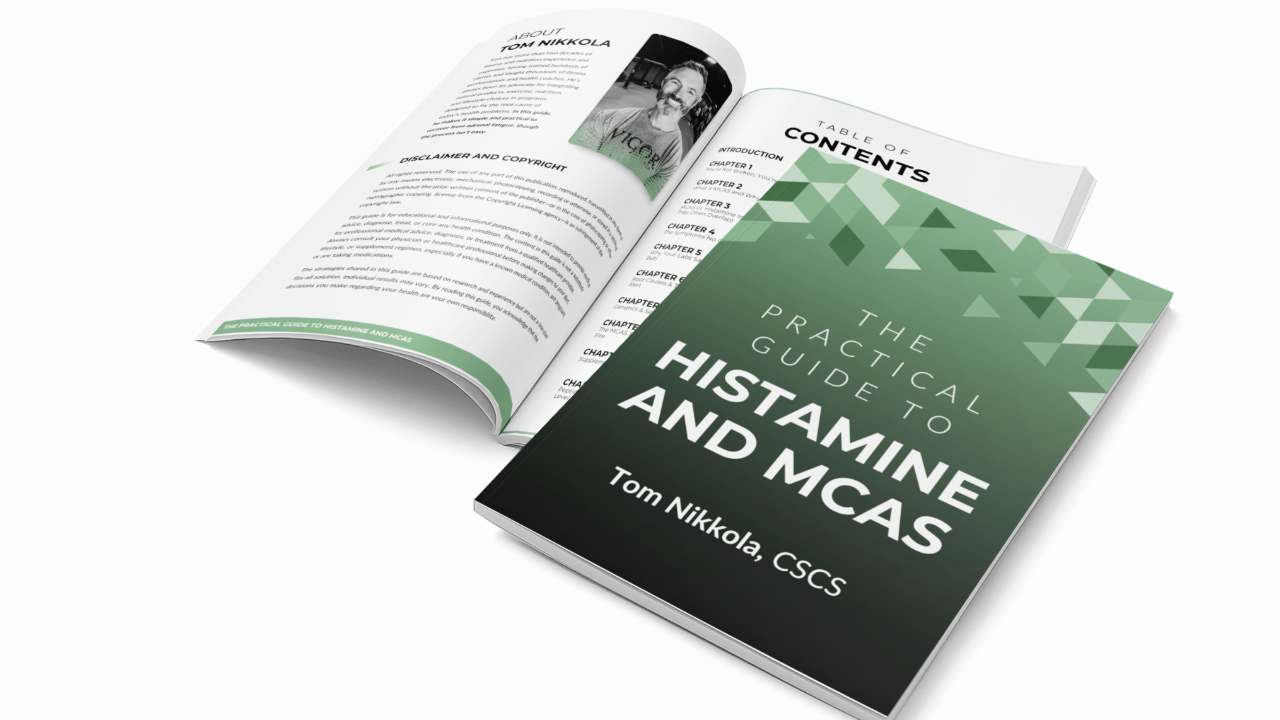
My SIBO Guide covers testing, breath test interpretation, and treatment protocols in detail. The Histamine & MCAS Guide addresses the mast cell side of the equation, including mast cell stabilization and histamine clearance.
Both guides are also part of the Full Practical Guide Library, which includes everything else you might need if MCAS and gut dysfunction are part of a more complex picture. And you even get all future guides for free if you own the full library.
If you want help making sense of your specific situation, a consultation is the fastest way to get a protocol that actually addresses the loop, not just one side of it.