Why MCAS Cases Exploded: COVID, Perimenopause, and Histamine
Sep 17, 2026Sometimes she says it in the first two minutes, because she found it herself at 2 a.m. and the symptom list read like her own diary. Sometimes she has never heard of it, and she spends ten minutes describing it perfectly with no name for any of it.
Either way the story has the same shape.
She ate whatever she wanted. Then, somewhere in the last few years, her body started treating ordinary things as threats.
Wine did it. So did leftovers, a scented candle, and the supplements she bought to feel better.
And the answers she got were:
"Your allergy panel is clean."
"It's anxiety."
"It's probably perimenopause."
"Try cutting out gluten and see how you feel."
So here's the question I keep getting. Is mast cell activation actually more common than it was in 2020, or has everyone simply learned the term?
Both are true. The second part matters less than you'd think, because three separate things changed at the same time, and only one of them gets argued about online.
1. A virus that reaches mast cells directly
Mast cells sit at every border of your body: your gut lining, your sinuses, your skin, the walls of your blood vessels, and the tissue wrapped around your nerves.
They're there to notice a threat and call for help, which they do by releasing histamine, tryptase, and about a thousand other compounds in the same moment.
In 2025, researchers publishing in the Journal of Virology showed something specific. The coronavirus spike protein binds to receptors on mast cells and sets off the chain inside the cell that makes them dump their contents: Src kinase, then PI3K and AKT, then a rush of calcium inside the cell, then release.
The virus doesn't have to infect the mast cell. The spike protein alone is enough.
That's the mechanism. The human side came earlier, in 2021, and it's the one I keep coming back to.
A group in St. Louis surveyed 136 adults with long COVID and asked them to score their mast cell symptoms twice: once as they remembered themselves before the infection, once as they were now. They ran the same survey on healthy controls, and on a separate group of diagnosed MCAS patients who had never had COVID.
Before infection, the long COVID group scored like healthy people. After, they scored like MCAS patients.
Those were the same people. Their bodies had changed underneath them.
Most people who caught COVID did not end up with MCAS. The ones who did were usually carrying a full bucket already: a rough few years, a gut that had been struggling for a decade, hormones on the way down.
2. The bucket was already filling
I use the bucket analogy in almost every consultation. It's the only frame that makes the randomness make sense.
Histamine is always there. Your body clears it all day long without telling you about it.
Symptoms show up when the bucket overflows, which means the reaction almost never comes from the one thing you ate right before it.
That's why it feels so random. You had the same glass of wine in March and felt fine.
So what else fills the bucket?
Estrogen activates mast cells. Progesterone calms them.
Progesterone is also the hormone that drops first in perimenopause, often years before estrogen does, and the largest group of women in history is moving through that window right now.
Chronic stress fills it too. Mast cells sit right next to nerve endings and take their cues from your nervous system, so think about what the last five years asked of most people's nervous systems.
Then think about the gut, where more than two thirds of your mast cells live. Antibiotics, low stomach acid, and years of daily acid blockers all change which bacteria grow, and some of those bacteria produce histamine themselves. So does the wine you're blaming.
None of that is new. What's new is how many people carry three or four of them at once. Then a virus arrives that pushes on mast cells directly.
3. It finally has a name
MCAS was first described in the early 2000s, the first formal criteria came in 2010, and most physicians practicing today finished their training before the term existed.
So part of the rise is real. Part of it is people finally finding a word for something they've had for fifteen years. Neither one makes your symptoms less real.
What I'd actually do about it
Here's where most people go wrong. They find the low histamine food list first, they build the whole plan around it, and then they take it personally when it quits on them.
That list lowers how much histamine goes into the bucket, but it does nothing at all about how full the bucket already sits, or how easily your mast cells fire once it's full. You get six weeks of relief. Then it stalls.
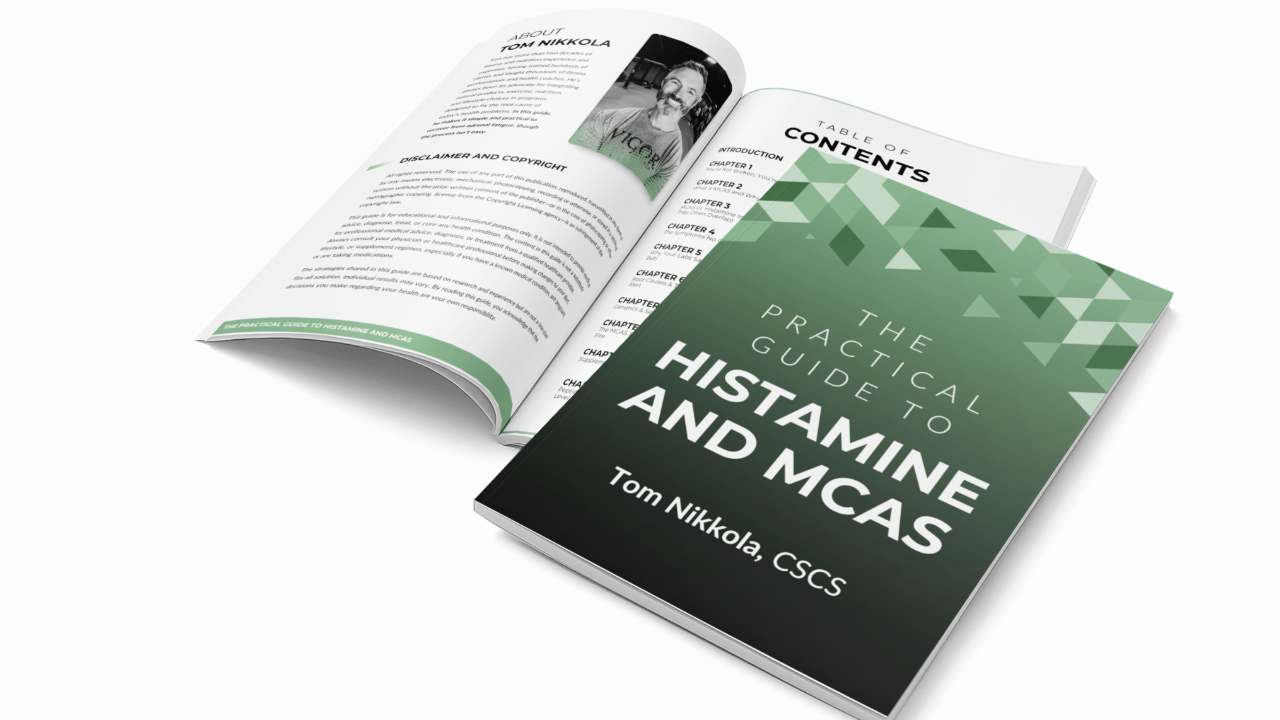
I sequence it backward. That order is what the histamine and mast cell guide walks through in full.
Start with digestion, not with mast cell supplements. Your stomach has to be as acidic as it's supposed to be, with bile support and the basic enzymes, before much of anything else works.
Most people tell me they tried digestive enzymes, got nothing out of them, and crossed them off, when the real problem was that their stomach acid sat too low to activate them.
Eat three meals, four to five hours apart, and stop snacking. That gap is what lets the migrating motor complex sweep leftover food out of your small intestine.
Snack through the afternoon and the sweeping stops, so food sits in there longer than it should, the bacteria already living down there get to work on it, and the histamine they make lands in the same bucket as everything else you've been carefully avoiding.
For about one in three people, that single change makes an obvious difference within a few weeks.
Train your nervous system instead of exhausting it. The foundation here is resistance training. My most sensitive clients start with one set of ten reps of three movements, three times a week. They do a squat down to a chair, a push-up with their hands up on a counter, and a row.
It doesn't feel like a workout, because it isn't one, and all you're doing is teaching your nervous system that a little effort is not an emergency. Add a set each week.
Check progesterone before you cut another food. If your flares track your cycle, or they showed up in your forties, hormones are doing more of the work than your diet is.
I'll add one caution here. The daily antihistamine cocktail, an H2 blocker with a Zyrtec or an Allegra, backfires over time, because suppressing stomach acid every day feeds the gut problem that fills the bucket in the first place.
For a bad flare, it's fine. As a daily habit, the benefits don't outweigh what it costs.
Make one change at a time. Two at the very most. Change five things at once and feel worse, and you've learned nothing about which one did it.
Where to go from here
My complete histamine and mast cell protocol is here. It covers the eight week stabilization sequence, the supplements that help, the ones that backfire, and the root causes. The link gets you $20 off.
One more thing belongs here, since I can say it in email and not on Instagram.
Of the roughly 230 of my clients using microdosed tirzepatide, about 60 percent of them deal with mast cell issues. Calming those reactions, not losing weight, is why many of them started, and the doses sit at a fraction of what gets used for weight loss. EllieMD is where my clients get it.
And if your situation has too many moving parts to sort out from a guide, that's what a consultation is for.
Do you know someone whose reactions started after a bad infection and never fully settled? Forward this to her. She's probably been told it's anxiety at least three times.