What low dose naltrexone actually does
Sep 10, 2026Last month, a client brought up low dose naltrexone near the end of our call, almost as an afterthought.
Her naturopath had prescribed it weeks earlier, but the bottle was still sitting in her kitchen cabinet, unopened, because she wanted my opinion before she started something new.
I get that question a lot. So let me walk you through what LDN actually does, who it helps, who should avoid it, and where I put it in the order as a health and fitness coach, not as a healthcare professional who treats and prescribes.
You probably know the feeling that leads people to this drug.
You've cleaned up your food and you space your meals four hours apart. The scented candles went in the trash a year ago, yet you still react to things that shouldn't matter.
By now you've heard every version of the response. "Your labs are normal." "It's probably anxiety." "Have you tried cutting out gluten?" You have.
You also cut dairy, histamine, and oxalates, yet you still can't walk past the candle aisle at Target without your face going red.
A tenth of a dose is a different drug
Naltrexone has been around since the 1980s. At 50 mg, it blocks your opioid receptors all day so that alcohol and opioids stop producing a high, which is why it's prescribed for dependence.
Low dose naltrexone is roughly a tenth of that, usually between 1.5 and 4.5 mg. At that dose, the opioid receptor block only lasts a few hours, which is how it turns out to have a pretty cool effect.
Nobody manufactures a 3 mg tablet, so a compounding pharmacy has to weigh yours out by hand, which is why the pharmacist at your grocery store can't fill it, but you're able to get it through some telehealth companies or through a doctor that uses a compounding pharmacy.
If you don't have a doctor who's willing to help you get started with it, and you're in the U.S., this compounding pharmacy offers LDN and you'll get 10% off your first order.
How LDN works
Why would a tenth of a dose do something completely different? It comes down to two mechanisms.
The first is the rebound. You take LDN at bedtime, and it blocks your opioid receptors for four to six hours while you're asleep. Because your receptors are blocked, you don't get the signal that endorphin levels are high enough. So, your body keeps producing more.
By morning the drug is gone, your receptors are no longer blocked, and you get the effects of higher than normal levels of endorphins.
Those endorphins do more than dull pain. They also calm immune cells down.
The second mechanism matters more for the people I work with. Naltrexone blocks a receptor called TLR4, which sits on microglia, the immune cells of your brain and spinal cord. When TLR4 gets switched on, those cells release inflammatory chemicals.
After years of that inflammation, your nervous system starts processing ordinary signals as pain, which is called central sensitization. Naltrexone occupies TLR4, so the cascade slows down.
What the evidence actually shows
I want to be careful here, because LDN gets oversold all the time.
The best-known trial is small. Thirty-one women with fibromyalgia took 4.5 mg a day, each of them spending part of the study on placebo without knowing when.
Pain dropped 28.8 percent on the drug versus 18 percent on placebo, while 32 percent of the women counted as responders compared with 11 percent.
That's a real effect. It's also only thirty-one people.
A larger fibromyalgia trial found no real difference from placebo, though it never signed up enough people to settle the question. It's out there. Anybody selling you LDN as a sure thing is leaving it out.
So where does that leave you? It's cheap, it's easy on most people, and the mechanism holds up.
The evidence behind it is modest, so it's worth trying. It is not worth building your whole plan around.
Where MCAS and histamine come in
"Would LDN work for me?" is the question I get most, and it's the one with the thinnest research behind it.
There are zero randomized trials of LDN in mast cell activation syndrome (MCAS), only case reports, patient surveys, and clinicians who swear by it.
In one survey, MCAS patients rated antihistamines a 6.3 out of ten for how much they helped, and LDN a 5.6. That's close, but it isn't better.
The mechanism is still interesting, because mast cells carry TLR4 too, and opioids happen to be mast cell activators, which is why some people come apart after a single dose of codeine in a hospital bed and never find out why.
So a drug that blocks TLR4 is at least working on a receptor your mast cells actually have.
And it works differently from other tools like mast cell stabilizers or antihistamines.
Even the physicians who prescribe it most will tell you the evidence is weak, then tell you in the same breath that some patients respond beautifully anyway. I've seen that split myself.
Who tends to respond
This is a pattern I watch for. I wouldn't call it a guarantee. LDN tends to help people whose pain is spread out and moves around rather than staying in one joint. It tends to help when symptoms started after an infection, a surgery, or a long stretch of stress that never let up.
It also helps with fatigue that has nothing to do with how much you slept, along with a nervous system stuck on high alert, where your heart pounds the moment your head hits the pillow.
The people it tends not to help are the ones whose real problem is still upstream. If your stomach acid is low, you're getting sixty grams of protein a day, and you eat five times a day so your migrating motor complex never gets its cleaning sweep, a 3 mg tablet won't fix any of that.
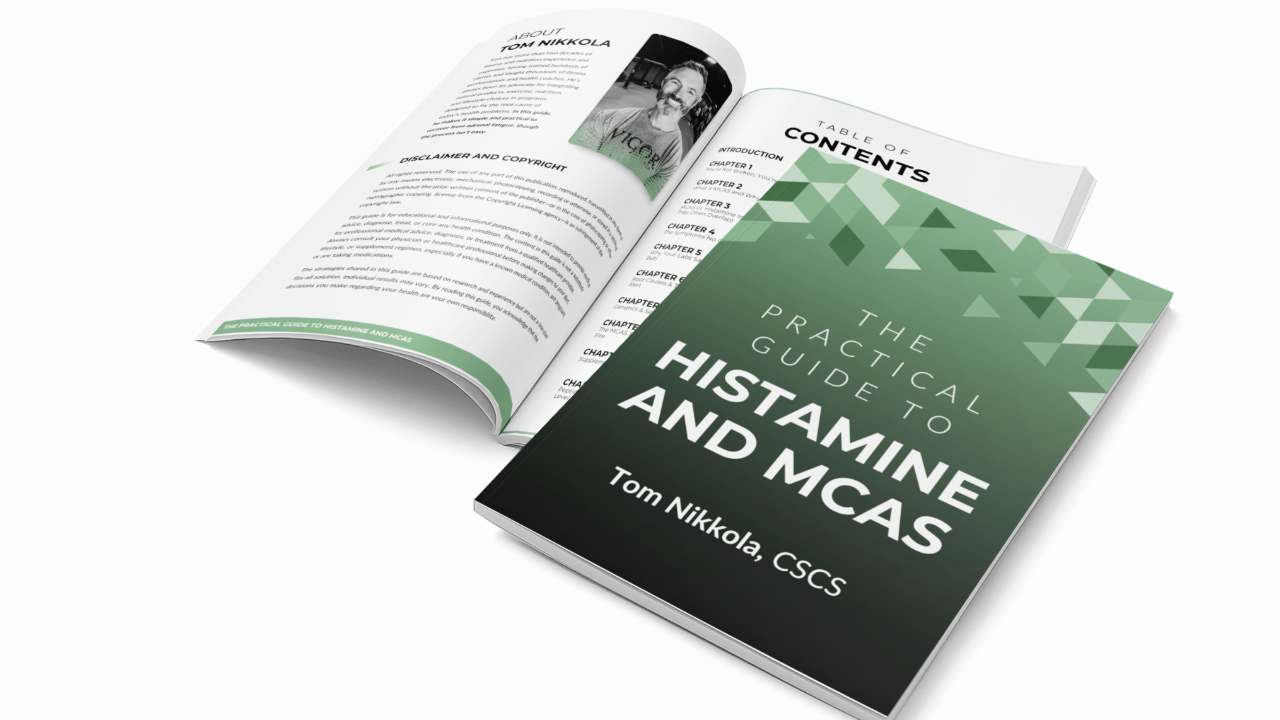
That's why I generally encourage my MCAS clients to consider LDN after they've got their foundation in place, similar to what I outline in my Histamine and MCAS guide.
Who should not take it
- Anyone on opioid pain medication should not take LDN. It blocks the opioid, which means the pain relief disappears and anyone who's physically dependent can go into withdrawal. Tramadol counts, so mention it.
- Anyone with surgery scheduled should stop at least seven days ahead.
- Anyone with active liver disease, or liver enzymes that keep coming back high, should hold off.
- Anyone pregnant or trying to conceive should skip it, because the safety data doesn't exist.
One more gets missed constantly. If you take thyroid medication, tell your prescriber first, because LDN can improve thyroid function enough that your usual dose becomes too much, so recheck your labs in two months.
Side effects are mild and mostly early. Vivid dreams are the famous one, and they're every bit as detailed and bizarre as people say, so much so that some people look forward to them.
Others move the dose to the morning and never have another one. Trouble sleeping hits about 8 percent of people and clears within two weeks.
When to bring it up with your doctor
More often than not, I'll walk a client through nutrition, lifestyle, and supplements first, then a peptide if it makes sense, and only then low dose naltrexone if she's still not where she wants to be, because by that point we both know exactly what the foundation can and can't do on its own. Here's the order:
- Digestion comes first, meaning stomach acid, bile, and enzymes, because most people who think they have a gut problem have a stomach problem.
- Then the foundation, which means protein at every meal, strength training, and sleep you can count on.
- Then mast cell support that doesn't need a prescription, like quercetin or luteolin, vitamin C, and magnesium.
- Then microdosed GLP-1, which lowers inflammation body-wide and settles the nervous system. For a lot of my histamine clients, that's the step that finally brings the flares down. I have a couple hundred clients on it. Fewer than a dozen are using it for weight.
If you've done all of that for a few months and you're still reacting, that's the conversation to have with your doctor, a functional medicine physician, or a telehealth provider.
Plenty of them will say "that's not really something I do." That isn't stonewalling. The evidence is thin and they're trained to wait for better.
What if you're the one with the bottle already in the cabinet? I'm not telling you to wait.
It's a very safe medication, so there's no reason to leave it sitting there while you rebuild the rest. Just don't expect it to do the rebuilding for you.
Ask for a slow build, starting at 0.5 or 1 mg and climbing over weeks instead of days. Give it eight to twelve weeks before you judge it.
LDN calms an inflamed nervous system, but it won't restock your protein, fix your stomach acid, or put you in bed on time. On top of a solid foundation, though, it may be the thing that finally gets you through an ordinary Tuesday without a reaction.
If you know somebody who's been told LDN is either a cure or a scam, send them this. It's neither.
Two next steps, depending on where you are.
If you're still working on the layers underneath LDN, that's the higher-value place to spend your energy right now. My Practical Guide to Histamine and MCAS walks through the digestion-first sequence, the supplements that calm mast cells, and the 8-week stabilization plan in the order I actually use them with clients.
If you've done the foundation and you want help deciding whether LDN, a peptide, or something else is the right next move for your situation, book a consultation and we'll map it out together.
And if microdosed GLP-1 is the step you haven't tried yet, that's the one I reach for before LDN with most of my histamine and mast cell clients. You can start here through EllieMD, the telehealth partner I use with my own clients.
If you don't have a doctor who's willing to help you get started with it, and you're in the U.S., this compounding pharmacy offers LDN and you'll get 10% off your first order.