Too Many Supplements? The Five I Keep, and Where a GLP-1 Fits
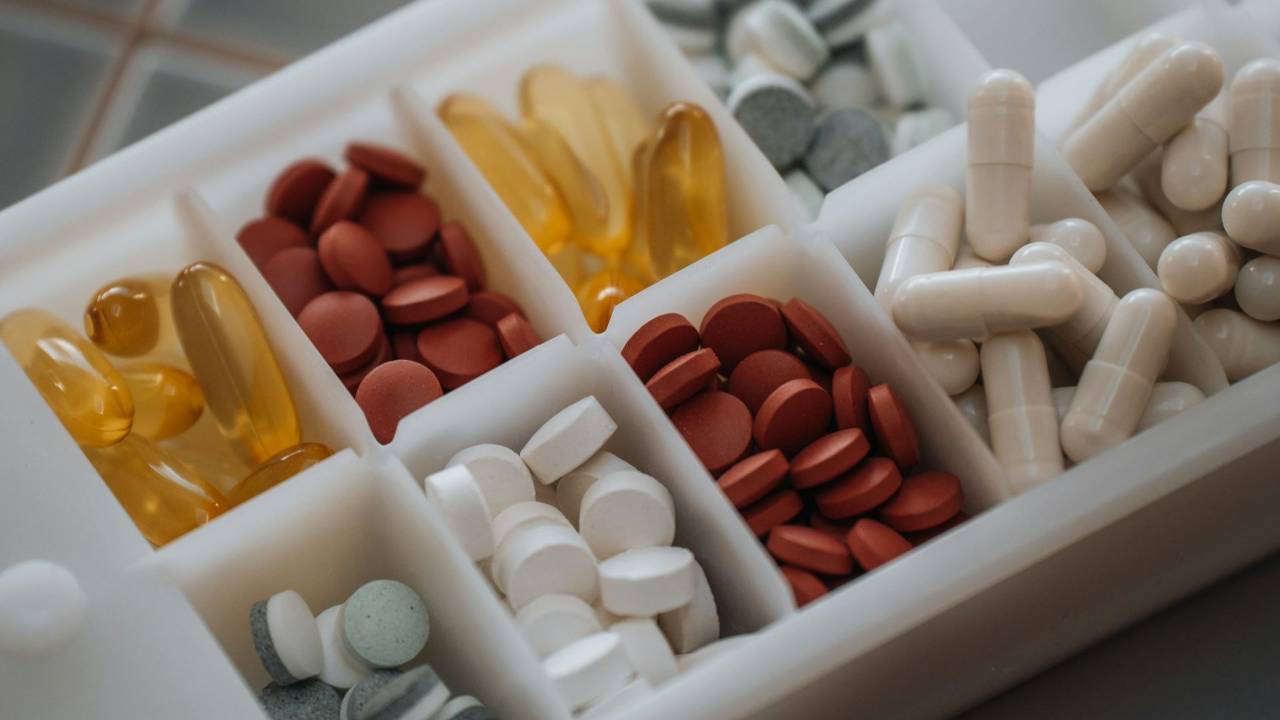
Oct 08, 2026Every Sunday night you fill a seven-day pill organizer, morning and evening. It takes about twenty minutes.
You keep the bottles you still take in the cabinet above the sink. Under the sink there's a grocery bag filled with the ones you quit opening sometime in the spring.
"You don't need to take all that." Maybe your sister said it. Maybe it was your spouse, standing at the open cabinet.
You laughed it off. Later, when nobody was around, you counted the bottles in the cabinet and the bag and got to 19.
Part of you thinks they're right.
The trouble is that nobody has ever told you which ones to stop. Every time you saw someone new, you went home with another bottle.
You're past mid-life, or getting close, and you've started thinking about the next twenty years. You want to spend them strong, lifting your own suitcase into the overhead bin. So which of these bottles are actually helping with that?
Five to eight is enough
Most of the clients I see have a cupboard that would rival GNC.
My goal is to get every client down to five to eight supplements. Short-term, it may require more, but that's to address something specific.
Long-term, if we need more than that, we're missing something somewhere.
I hold myself to the same rule. My wife and I still have a shelf full of bottles at home, but day to day, I take about eight.
The five I start almost everyone on
I call these my Foundational Five, and almost everyone starts here before we add anything else.
A multivitamin, in a form your body tolerates. Food alone won't cover every vitamin and mineral you need, even when you eat well.
The form matters, though. From my experience, about one in three women don't feel good on methylated B vitamins.
If a B complex ever made your heart race or left you wired and irritable, the methylated form may have been the reason. Some companies make multivitamins without it.
Magnesium. It helps your muscles relax and keeps your blood sugar steadier, and a lot of women feel calmer on it. No multivitamin can fit enough of it, so it's always a separate bottle. And it's the second most common micronutrient deficiency, next to vitamin D.
Vitamin D with K2. You probably don't get enough sun to make the vitamin D you need to maintain an optimal vitamin D level of 60-80 ng/dL.
Most people need at least 5,000 IU a day in addition to what a multivitamin might provide.
I've never had a client test too high at that amount.
A digestive formula with acid, bile, and enzymes. I recommend this one more than any other supplement. It helps your stomach break down the extra protein you're about to start eating. Almost all of the gut-related issues people experience, including dysbiosis, SIBO, and even GERD and IBS have something to do with reduced acid and bile levels.
It's even one of the essential supplements for those wtih MCAS.
Creatine. If you have a tub of creatine you never opened, open it. It's one of the most studied supplements there is, and it's cheap.
At 5 grams a day, people usually notice it in their strength and their workouts over the first month. Some women notice clearer thinking when they go up to 10 grams.
My creatine guide goes deep on this. You can access it for free here.
That's the five. If you add a sixth, seventh, or eighth, it should be for one specific thing, like sleep or a lab that came back low.
I put the foundational five together on Fullscript, the supplement dispensary I use with clients. Here's the plan. It lists more than one multivitamin so you can choose the form that suits you, and you only need one.
What I usually tell women not to reorder
When a client holds her bottles up to the camera on our call, these are the ones I most often tell her to let run out.
Single B vitamins and high-dose methylfolate. A good multivitamin already covers the B vitamins, and the magnesium you take separately helps your body use them. Vitamins don't work in isolation, they work together, so it's extremely rare that a single micronutrient ends up being better than If your doctor prescribed one of these, keep taking it.
Duplicates. I often find quercetin in two different products, turmeric in three, and a hair, skin, and nails blend that repeats half of the multivitamin.
Amino acid supplements in place of protein. Eight grams of amino acids isn't the same as 30 grams of protein, even if the company sells it that way.
You don't have to throw anything away. Let one bottle run out at a time and pay attention for a week or two.
If you feel worse after a bottle runs out, that one is worth reordering. If you feel the same, you just saved the money.
Women with low bone density lifted heavy, and their bones got denser
So let's go back to your question about the next twenty years. A few of those bottles help, but you won't build bone from a capsule. Bone gets denser when muscle pulls on it and when it takes the jolt of landing.
Women with low bone density usually hear some version of "Be careful." A group of researchers in Australia wanted to know what would happen if those women lifted heavy anyway.
They recruited 101 women past menopause, average age 65, all with low bone density. About half did a gentle exercise program at home.
The other half came in twice a week for 30 minutes, with trainers watching every rep. They did five sets of five with weights at least 85 percent of the most they could lift once, plus some jumping and landing.
After eight months, the lifters had added almost 3 percent to the bone density in their spines, while the home group lost about 1 percent. In all that time, one woman in the lifting group reported a minor back spasm, and nobody reported anything else.
The lifters even gained about 2 millimeters of height. The home group lost about 2. I had to read that twice.
If you're new to lifting, you don't have to start that heavy. My clients usually start with one set each of a leg press, a chest press, and a row, three times a week, which takes about five minutes.
That's on purpose. They add a set each week and another exercise every week or two, so by about 12 weeks they're doing a full workout. If you already lift, keep going, and keep adding weight.
I think of muscle like a retirement account. The more you have when you start losing it, the longer you can keep losing it and still live the way you want. And at the same time, it's never too late to start depositing into your account, meaning you're never too old to start weight training.
You need more protein now than you did in your 20s
The women I talk with eat less protein than they used to, right when they need more of it.
Needing more protein has a name, anabolic resistance. Your muscles respond less to the same amount of protein as you get older, so if you could get by with 80 grams a day in your 20s, you probably need something more like 100 to 120 grams in your 50s just to hold on to the muscle you have.
At least 30 grams at every meal, starting with breakfast, is the floor. Over time, I want women working toward about 0.8 grams per pound of the weight they'd like to be.
My own breakfast is a protein bar and a container of Greek yogurt, about 50 grams together. The purists would tell me it's processed, but I feel great and my labs look good.
When you eat out, ask for double protein. You'll probably skip the chip basket, too.
If protein sits in your stomach for hours, look at your acid
Some women add protein and feel like it sits in their stomach all afternoon. That usually means their stomach isn't making enough acid.
I like to tell clients their stomach should be like battery acid. You need that acid to break protein down, and a lot of us make less of it as we get older, so the protein moves along half-digested and ferments in the intestines, which is often where gas and bloating come from.
In my experience, reflux is usually a sign of too little acid, not too much. An acid blocker eases the burn, but it lowers your acid further, so protein gets even harder to digest.
That's what the digestive formula in the five is for. It puts acid, bile, and enzymes in one capsule.
If you take an acid blocker, talk with your doctor before you add the digestive formula, and ask whether you still need the blocker.
If you're considering a GLP-1, build this first
You might already be on a GLP-1. You might also have crossed it off your list because you heard it takes your muscle and your bones.
Researchers in Copenhagen put 195 adults with obesity on an 800-calorie diet of meal replacements for eight weeks. Then they split them into four groups for a year: a daily GLP-1 called liraglutide, an exercise program, both, or neither.
By the end of the year, the people who took the drug and didn't exercise had lost a little bone at the hip and spine compared with the people who only exercised or got neither. The people who took the same drug and exercised lost the most weight of anyone, about 37 pounds on average, and they kept their lean mass.
Their bones did no worse than the group that got neither, even though that group lost less than half as much weight.
That matches what I see in clients. When people lose muscle on a GLP-1, it's because they didn't change how they eat or start lifting. Not because they started a GLP-1.
About 230 of my clients use tirzepatide, the medication in Mounjaro and Zepbound. Most of them aren't using it to lose weight.
What they tell me most often is that their joints ache less and the cravings fade. I can't promise that for you, and nobody has studied it at the doses my clients use.
Digestion matters here, too. I'd estimate three out of four people start a GLP-1 with low stomach acid, low bile, or low enzymes, and the medication also slows how fast food leaves your stomach.
That's why my clients keep taking the digestive formula, even on a very small dose of tirzepatide.
If you or a close relative has had medullary thyroid cancer or a rare condition called MEN2, tirzepatide isn't for you. If you've had pancreatitis or gallbladder trouble, make sure your prescriber knows before you start.
Severe belly pain on any GLP-1 means you call your provider that day.
Most of my clients U.S. get their tirzepatide here.
Where to be careful
If you take warfarin, ask your doctor before adding vitamin K2.
If you have an ulcer or gastritis, or you take NSAIDs or steroids every day, talk with your doctor first and use an enzyme formula without acid. If you have kidney disease, kidney stones, or high calcium, talk with your doctor before taking magnesium, creatine, or vitamin D at these amounts.
Don't stop a prescription, including an acid blocker, without your doctor. If you've had a spine fracture, talk with your doctor and work with a trainer before you add weight.
If you've had cancer, bring your oncologist into any new plan.
Where to go from here
If you want the foundation in one place, I've put the five together on Fullscript. Get the Foundational Five. Choose one multivitamin from the plan, not all of them.
If you still have more than eight bottles of supplements and don't know what to keep taking and what to stop, book a consultation, and we'll sort through everything together based on your goals, needs, history, etc.
This is education, not medical advice. Talk with your doctor before you start or stop any supplement or medication.