Three GH Peptide Options. One is Right For You.
Mar 18, 2026If you’ve been looking into peptide therapy, maybe you’ve heard about sermorelin, or you’ve seen ipamorelin mentioned somewhere, you’ve probably also noticed that the options keep expanding.
That’s mostly a good thing.
More options means more precision. But it also means more confusion about where to start, what actually works, and whether the newest thing is worth your attention or just noise.
Today I want to clear that up.
EllieMD now offers three distinct growth hormone peptide options: sermorelin, ipamorelin + tesamorelin, and the newly launched tesamorelin + KPV. Each one works differently. Each one is right for a different person.
Let me show you how to think about it.
First: Why the Growth Hormone Axis Even Matters
Your body doesn’t produce growth hormone in one long, steady stream. It releases it in pulses, mostly during deep sleep and after intense exercise, and those pulses drive everything from fat metabolism and muscle repair to cognitive sharpness and tissue regeneration.
After your mid-30s, those pulses get weaker, shorter, and less frequent. You don’t lose growth hormone entirely. You lose the amplitude.
The result is subtle at first... a little more belly fat that won’t budge, less recovery between workouts, sleep that doesn’t quite restore you the way it used to. Over time, it compounds.
Peptides that support this pathway don’t flood your body with growth hormone. They work upstream, prompting the brain and pituitary to release more of what you’d naturally produce, just more of it, more consistently.
Key point: Think of your growth hormone system like a radio signal that gets weaker with age. These peptides don’t replace the signal. They help your body broadcast it more clearly again.
That’s the framework. Now let’s talk about the specific options.
Option 1: Sermorelin: The Clean Entry Point
Best for: Someone new to peptide therapy, dealing with chronic stiffness or pain, or primarily looking for better sleep and tissue recovery.
Sermorelin is a synthetic analogue of GHRH, growth hormone-releasing hormone. It mimics the signal your hypothalamus would naturally send to your pituitary to trigger a growth hormone pulse.
It has the longest clinical history of any GH peptide in this class. It’s well-tolerated, predictable, and for many people, it’s all they need.
But here’s what I didn’t expect when I first started using it.
I’ve dealt with persistent neck stiffness and joint irritation since a serious spinal injury after breaking my neck a few years ago. Mornings were rough, stiff neck, subtle headache, guarded movement getting out of bed. I’d accepted it as part of life after the injury and spinal fusion.
The first night I used sermorelin, I woke up without pain.
I thought it was a fluke. But the pattern held. Nights I used sermorelin, no pain. Nights I skipped it, stiffness came back. When I switched to other GH peptides, the pain returned. When I came back to sermorelin, it was gone again.
Not reduced. Gone.
That got me asking a different question: not “Does sermorelin increase growth hormone?” but why does it seem to reduce inflammation and tissue irritation in a way other peptides don’t?
The Tissue Repair Angle Most People Miss
Most conversations about growth hormone focus on fat loss, muscle gain, and anti-aging. Those benefits are real. But they’re not the whole story.
Growth hormone plays a significant role in collagen remodeling, connective tissue integrity, joint lubrication, disc health, and inflammation signaling. It doesn’t just help you build tissue. It helps you maintain and restore tissue quality.
For people who wake up stiff, carry old injuries that never fully resolved, or feel inflamed without a clear explanation on labs, that distinction can be everything.
Sermorelin also works differently than GH peptides that act through the ghrelin receptor. Because it follows the full GHRH signaling cascade, it produces a more rhythmic, physiologically coordinated GH response, one that syncs with sleep architecture and overnight repair processes in a way some people feel very clearly.
I think that’s why it helps with pain in a way other peptides don’t, at least for me. It’s not suppressing pain signals. It’s improving the conditions under which tissue actually heals.
Key points: If you wake up stiff, achy, or feel like your body stopped repairing itself overnight, sermorelin may be doing something more meaningful than you’d expect from a ‘starter’ peptide. Think of it as a nightly repair signal, not just a body composition tool.
People who tend to do well with sermorelin:
- Chronic stiffness or old injuries: the tissue repair and collagen remodeling benefits are real and often underappreciated
- Sleep issues: improved GH pulsatility is closely linked to deeper, more restorative sleep
- New to peptide therapy: well-tolerated, simple protocol, good starting point
- Older adults: gentler, more physiologic stimulation suits a conservative anti-aging approach
- Current GLP-1 users: sermorelin complements rather than competes, GLP-1s don’t address tissue repair or joint integrity
Tap here to get started with sermorelin.
Option 2: Ipamorelin + Tesamorelin: The Performance Stack
Best for: Someone who wants meaningful body recomposition, especially visceral fat reduction, improved recovery, and measurable IGF-1 optimization.
This is where the science gets more interesting.
Tesamorelin is a stabilized GHRH analogue, more potent and longer-acting than sermorelin. It’s the only GH peptide with FDA approval, earned through its demonstrated ability to reduce visceral adipose tissue. Clinical trials showed meaningful reductions in deep abdominal fat independent of diet.
Ipamorelin works through a completely different mechanism. It mimics ghrelin, a hormone that signals the pituitary to release growth hormone, and amplifies the size of the GH pulse. It doesn’t initiate the pulse; it makes the pulse bigger when it happens.
Together, they hit both ends of the GH release pathway simultaneously. Tesamorelin triggers the signal. Ipamorelin amplifies the response.
Key point: Think of GH release like a door opening. Tesamorelin turns the handle. Ipamorelin pushes the door all the way open. Together, you get a fuller release than either one could produce alone.
This stack is a strong fit when:
- Visceral fat is the primary target — particularly stubborn abdominal fat that doesn’t respond to diet alone
- IGF-1 is measurably low on labs
- You’re already metabolically engaged, eating well, training consistently, and want a meaningful upgrade
- Recovery between workouts is sluggish and GH axis decline is likely a factor
- You want the highest-output GH protocol available without using exogenous growth hormone
Tap here to get started with ipamorelin + tesamorelin.
Option 3: Tesamorelin + KPV: The New Stack for Inflammation-Driven Dysfunction
Best for: Someone dealing with systemic inflammation, MCAS, gut permeability, or mast cell reactivity, where immune burden is the underlying obstacle to feeling better.
This one just became available, and I want to spend more time here because it represents something genuinely different.
On the surface, tesamorelin + KPV looks like another GH stack. It isn’t, at least not entirely.
KPV is a tripeptide fragment of alpha-MSH (melanocyte-stimulating hormone), and it operates in a completely different lane than tesamorelin.
KPV’s primary action is anti-inflammatory. It binds to melanocortin receptors and directly suppresses NF-κB, one of the master switches of inflammatory signaling in the body.
It also supports intestinal barrier integrity, helping reduce the gut permeability that drives chronic systemic immune activation.
Key point: NF-κB is basically the body’s inflammation alarm system. When it’s stuck in the “on” position, everything hurts more, reacts more, and heals less. KPV helps turn that alarm down, especially in the gut, where a lot of chronic inflammatory load originates.
Tesamorelin brings GH support. KPV handles the inflammatory load. That combination is meaningful for a specific type of person.
Why This Stack Is Worth Paying Attention to If You Have MCAS
MCAS, mast cell activation syndrome, is a condition where mast cells become overly reactive, releasing histamine and other inflammatory compounds in response to triggers that wouldn’t affect most people.
Food, temperature, stress, fragrance, hormonal shifts, almost anything can tip the bucket.
Here’s what most people miss about MCAS: mast cells aren’t just passive responders. They’re active regulators.
They live throughout the gut lining, the skin, the nervous system, and the brain. When they’re chronically overactivated, they contribute to intestinal permeability, neuroinflammation, and hormone disruption, and they amplify other inflammatory pathways at the same time.
It becomes a feedback loop. Inflammation activates mast cells. Mast cells drive more inflammation. You feel reactive to everything, recover from nothing, and can’t figure out why the standard approaches don’t work.
KPV interrupts that loop at the signaling level.
By suppressing NF-κB and supporting gut barrier integrity, it reduces the inflammatory input that keeps mast cells on high alert.
Research in gut inflammation models shows meaningful protection against intestinal inflammation and mucosal damage, relevant because gut permeability is one of the primary triggers keeping mast cells activated in the first place.
For someone whose GH axis has declined but who also carries a high inflammatory load, and who hasn’t tolerated other peptide protocols well, tesamorelin + KPV addresses both sides of the problem simultaneously.
Tap here to get started with the tesamorelin + KPV peptide combonation.
It would be a perfect complement to low-dose tirzepatide.
Choosing the Right Option
Here’s a simple way to think about it:
- Sermorelin if you’re new to peptides, dealing with chronic pain or stiffness, want better sleep, or want to complement a GLP-1 with tissue repair support.
- Ipamorelin + Tesamorelin if you’re metabolically engaged and want meaningful GH axis optimization — visceral fat, improved recovery, IGF-1 support.
- Tesamorelin + KPV if you have MCAS, systemic inflammation, gut permeability, or you’ve struggled to tolerate other protocols.
If You’re Not Sure Where You Stand
Sometimes the harder part isn’t choosing between options, it’s knowing what’s actually driving your symptoms in the first place.
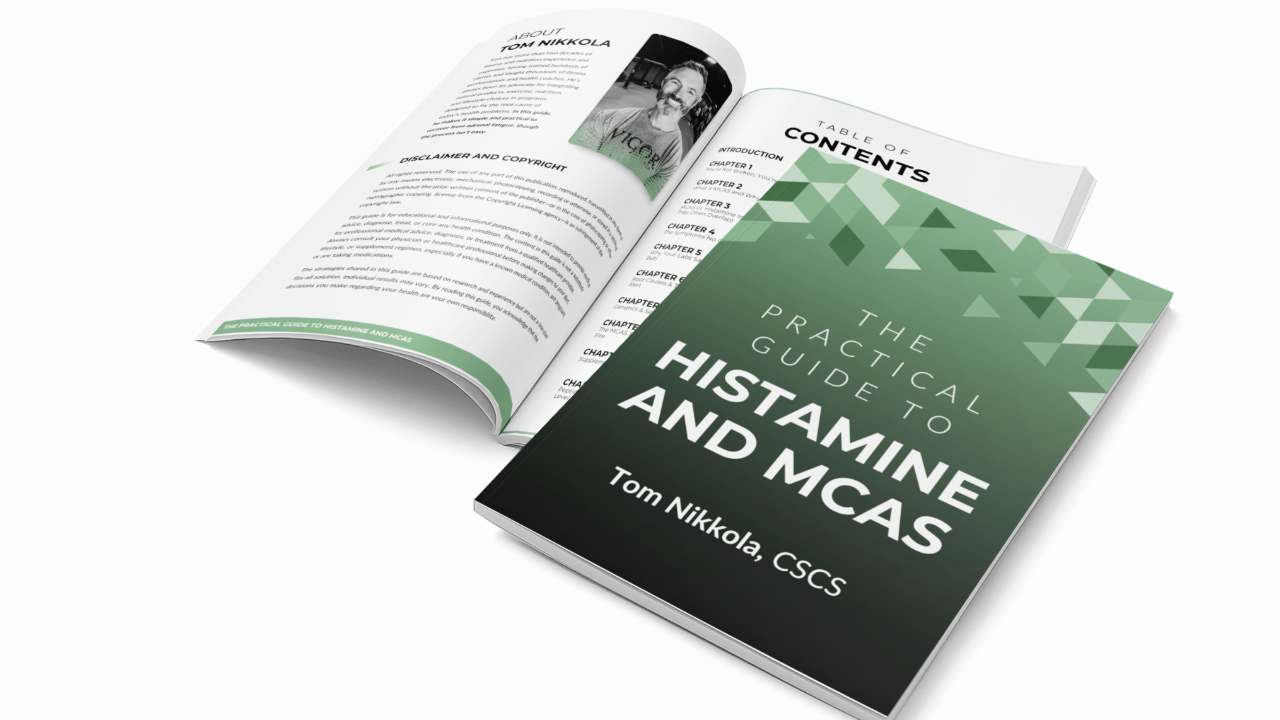
If you suspect histamine reactivity, MCAS, or gut dysfunction is part of your picture, my Practical Guide to Histamine and MCAS covers the mechanisms, the triggers, and what to do about them in plain language.
And if you want to work through this with me directly, you can book a consultation here. We’ll look at your full picture... labs, symptoms, history... and figure out what actually makes sense for you in terms of a complete nutrition and lifestyle plan, including peptides.