One injection. Four healing peptides. Meet KLOW.
Apr 29, 2026You used to bounce back. A tough workout, a poor night of sleep, a stretch of high stress, your body absorbed it all and kept moving. Then somewhere in your forties, the math changed.
The hike that used to feel good now leaves you sore for two days. Cuts and bruises take longer to fade. Your skin thins, your hair sheds faster than it grows, and the same gut you trusted for decades suddenly reacts to foods you've eaten your whole life.
It is not in your head. It is biology shifting beneath you.
Estrogen drops. Growth hormone declines. Copper transport gets less efficient. Mast cells get twitchier. The repair signals your body once produced in abundance start arriving in trickles.
That is the gap KLOW is built to fill.
What KLOW actually is
KLOW is a single injection containing four peptides that target different repair pathways. Until recently, women who wanted these had to source each one separately, mix vials, schedule overlapping injections, and pay four separate prescription fees.
The telehealth company my clients and I use just released a formulation that puts all four into one shot, prescribed and overseen by a licensed clinician.
The four peptides:
- BPC-157, for gut lining and connective tissue
- TB-500, for systemic recovery and joint health
- GHK-Cu, for skin, hair, and collagen
- KPV, for inflammation and mast cell calming
Each peptide solves a piece of the puzzle. Together, they cover most of what slows down in a midlife body.
Tap here if you already know about KLOW and are ready to get started!
BPC-157, the gut and tissue rebuilder
BPC-157 is a fragment of a protein found in human gastric juice. It supports the body's ability to rebuild damaged tissue by upregulating growth factors and improving blood flow to injured areas.
The most studied benefits show up in the gut wall and connective tissue. People with reflux, leaky gut, ulcer-prone tissue, or stubborn tendinopathy often respond to it first.
If you have worked through histamine intolerance or MCAS, you already know the gut wall sits at the center of the story. A leaky gut allows undigested proteins and bacterial fragments into circulation, which keeps the immune system in low-grade panic and feeds chronic histamine release.
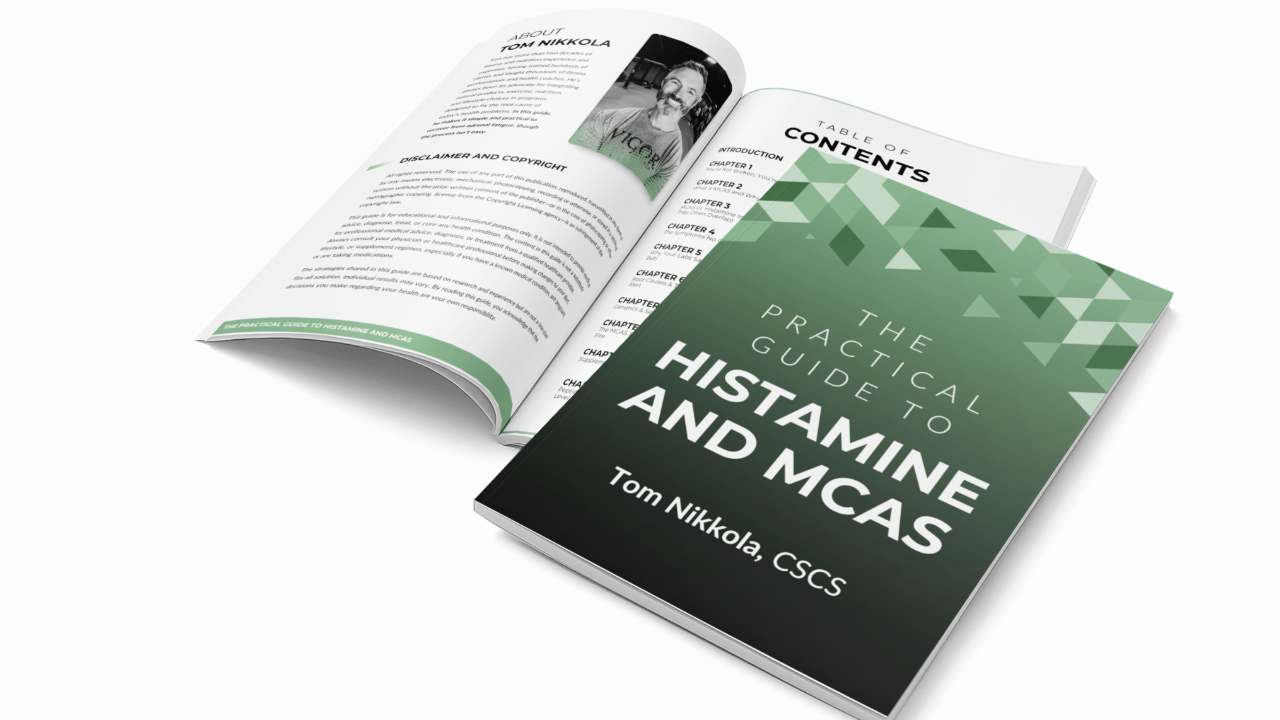
BPC-157 reinforces that wall while the rest of the stack calms the inflammation that damaged it. (If histamine is part of your story, my [Histamine and MCAS Guide hyperlink text] walks through the rest of the protocol.)
TB-500, the connective tissue specialist
TB-500 is a fragment of Thymosin Beta-4, a protein involved in actin assembly and cell migration. In simpler terms, it helps repair cells reach the places that need them.
Athletes use it for tendon and muscle recovery. Women in perimenopause often feel its impact in the joints, hips, and shoulders that started complaining without warning.
It pairs naturally with BPC-157 because they target overlapping but distinct repair pathways. BPC-157 builds the structure. TB-500 makes sure the right cells show up to do the building.
The two together explain why so many practitioners stack them, even outside the KLOW context.
GHK-Cu, the skin, hair, and collagen peptide
GHK-Cu is a copper-bound tripeptide that influences over 4,000 genes related to repair, regeneration, and antioxidant defense. It is the peptide most associated with visible changes in skin and hair.
Copper is a cofactor your body needs for collagen crosslinking, elastin formation, and oxidative balance. As estrogen drops, copper transport falters, and skin starts looking thinner and crepier even in women who eat well and lift consistently.
GHK-Cu delivers copper to the tissue that needs it. The downstream effect shows up in firmer skin, thicker hair, faster wound closure, and a healthier scalp.
For women who have spent years on collagen powders without seeing the change they hoped for, GHK-Cu often does what oral collagen could not.
KPV, the quiet anti-inflammatory
KPV is a three-amino-acid fragment of alpha-melanocyte-stimulating hormone. It blocks NF-kB signaling, which is one of the master switches for chronic inflammation in the body.
For women with histamine issues, MCAS symptoms, or autoimmune-flavored gut and skin reactivity, KPV is the quiet workhorse of this stack. It lowers the inflammatory tone of the entire body so the other three peptides can do their structural work.
You can think of it this way. BPC-157 and TB-500 are the construction crew. GHK-Cu is the finish carpenter. KPV is the one who makes sure the building isn't on fire while everyone else is working.
That is why all four belong in one shot.
Why a single injection?
Many, many of my clients use more than one peptide and have often asked why they couldn't get them all in a single vial.
While that's not possible for all peptides as some wouldn't be stable with others, it is possible with these four synergistic peptides. It just makes things easy.
Who benefits most
KLOW is not for everyone. It is most useful for:
- Those who feel recovery has slowed since their late thirties
- Anyone working through gut dysfunction, food reactivity, or histamine load
- Athletes and lifters with chronic tendon or joint complaints
- Women whose skin and hair started changing alongside their hormones
- Anyone rebuilding after surgery, illness, or a long stretch of high stress
If any of those describe you, KLOW is worth a closer look. If a few of them do, it might be one of the highest-return investments you can make in the next twelve months of your life.
How KLOW fits with what you are already doing
KLOW is a repair amplifier, not a replacement. It sits on top of the inputs that decide whether any peptide protocol works:
- Adequate protein, around one gram per pound of your goal bodyweight
- Resistance training that signals the muscle and tendon to remodel
- Sleep that lets growth hormone do its real job
- Methylation support if your genetics demand it (the MTHFR Guide covers this)
Without those, peptides give you diminishing returns. With them, peptides accelerate every input you are already paying for.
This is also why I rarely suggest peptides as a first move. If your foundations are loose, you will spend money chasing a result that protein, sleep, and lifting could have delivered for free. If your foundations are solid and you have hit a plateau, peptides are often the next logical step.
What to expect, and what not to expect
KLOW is not a stimulant. You will not feel it the way you feel caffeine or even a GLP-1.
The changes show up over weeks. Skin texture shifts first for many women, usually around week three or four. Joint and tendon complaints often quiet down by week six. Gut tolerance and hair changes tend to come later, around weeks eight to twelve.
This is biology rebuilding itself in the background. Patience is part of the protocol.
Four peptides. One injection. A body that finally feels like it is repairing instead of just running down.