This is Why Low-Carb Makes You Miserable
Sep 22, 2026A client of mine eats cleaner than almost anyone I work with. Every meal comes out of his own kitchen, and nothing on his plate comes from a bag. He'd fixed his blood pressure and his blood sugar, and he was still so tired that he'd sit in a chair, hungry, without the energy to walk to the refrigerator.
Then one night he ordered a pizza. "It was the most energy I've had in months," he told me, a little sheepishly, like he'd been caught at something.
He hadn't been caught. He'd found something, and you may have done the opposite experiment on yourself without knowing it.
You went low-carb to stabilize your energy, and it worked. Your energy is stable now. It's also low, all the time, and it's been that way long enough that you've stopped expecting anything else.
Your hands are cold in a warm house. Every afternoon has a flat stretch in it somewhere between two and four, while your workouts don't seem to do anything anymore no matter how consistent you are.
So you asked for a thyroid panel, and it came back fine. "Everything looks normal." Maybe you also heard "it's probably your age," or "have you tried cutting carbs?" You had. That was the point.
Let me walk you through what that panel measured, what it didn't, and why cutting carbs can lower the one number nobody checked without moving the one number everybody does.
Two hormones, and the panel measured the wrong one
Your thyroid mostly makes T4, which is the storage form and doesn't do much on its own. Your liver, your gut, and your muscle have to convert it into T3, the active form, before your cells can use it for energy.
TSH rises when T4 runs low and settles when T4 is enough. It tracks production. It says nothing about whether you're converting any of it.
So the standard panel is TSH and free T4, and both of them can sit comfortably in range while free T3, the number your afternoons actually depend on, drifts to the bottom of its range or below it. Free T3 is the one your doctor didn't order. It's the one that fell.
What does a pizza have to do with your thyroid?
Carbohydrate intake is one of the signals that sets how much T4 your body converts to T3. When carbs stay low for long enough, conversion slows. It's the same response your body makes to fasting, which makes sense as a survival setting, because less fuel coming in means your metabolism turns down to match.
Researchers tested this directly. They put eleven healthy adults through three weeks of very low carb and three weeks of higher carb, with calories held identical so that the only thing that changed was the carbohydrate.
On low carb, free T3 fell from 4.8 to 4.1. T4 went up. TSH didn't move.
Here's the detail that matters. Every one of those numbers stayed inside the normal range, so any of those eleven people would have heard exactly what you heard.
A harsher version of the same experiment ran back in 1976, when researchers put adults on 800 calories a day and varied only the carbohydrate to see what it did on its own. At zero carbs, T3 fell 47 percent.
With at least 50 grams of carbs on the same 800 calories, it held. Fifty grams is a potato and an orange.
Low-carb eating does help for a lot of people short-term, because triglycerides come down, blood sugar steadies, and PCOS gets better, so not everyone who eats low-carb needs to change anything. Especially if you're not sticking with it long-term.
But if you feel the way I described while your panel says normal, the drop is the first place I'd look.
The other half of the equation
Carbs aren't the only thing that turns conversion down. Stress does it too, because cortisol pushes T4 toward reverse T3, an inactive form that blocks the real thing.
Low ferritin does it, because the enzyme that converts T4 needs iron. So does low selenium.
I said this to the client with the pizza, and I'll say it to you. A combination of stress and not enough carbs is a perfect combination for suppressed thyroid function.
The tiredness it produces isn't the difference between caffeinated and not caffeinated. When you don't have enough T3, your cells can't produce enough energy, so everything feels heavy.
How low-carb turns into a cortisol problem
There's a second thing that happens when carbs stay low for a long time. It shows up at night before it shows up in a lab.
Your liver keeps a small store of glucose to hold your blood sugar steady between meals and through the night. On a low-carb diet that store runs small, so somewhere between two and four in the morning your blood sugar dips, which leaves your body one way to bring it back up.
It releases cortisol and adrenaline. You wake with your heart going, wide awake and tired at the same time, and you don't know why.
Do that every night for a year and you've trained a cortisol pattern, flat in the morning, a crash in the afternoon, and a second wind at ten at night when you should be asleep. That's the pattern people call adrenal fatigue, and low-carb is one of the more reliable ways I've watched women build it.
A 2012 trial in JAMA measured exactly this. Researchers checked cortisol and inflammation in adults holding their weight on three different diets, and the very-low-carb group had the highest of both. The diet that "stabilized" energy during the day was raising the stress hormone underneath it.
And cortisol, remember, is the other thing that pushes T4 toward reverse T3, so the carbs and the cortisol are working on the same enzyme from two directions. That's why I don't consider the middle-of-the-night wake-up a separate problem from the cold hands, because it's the same problem at a different hour.
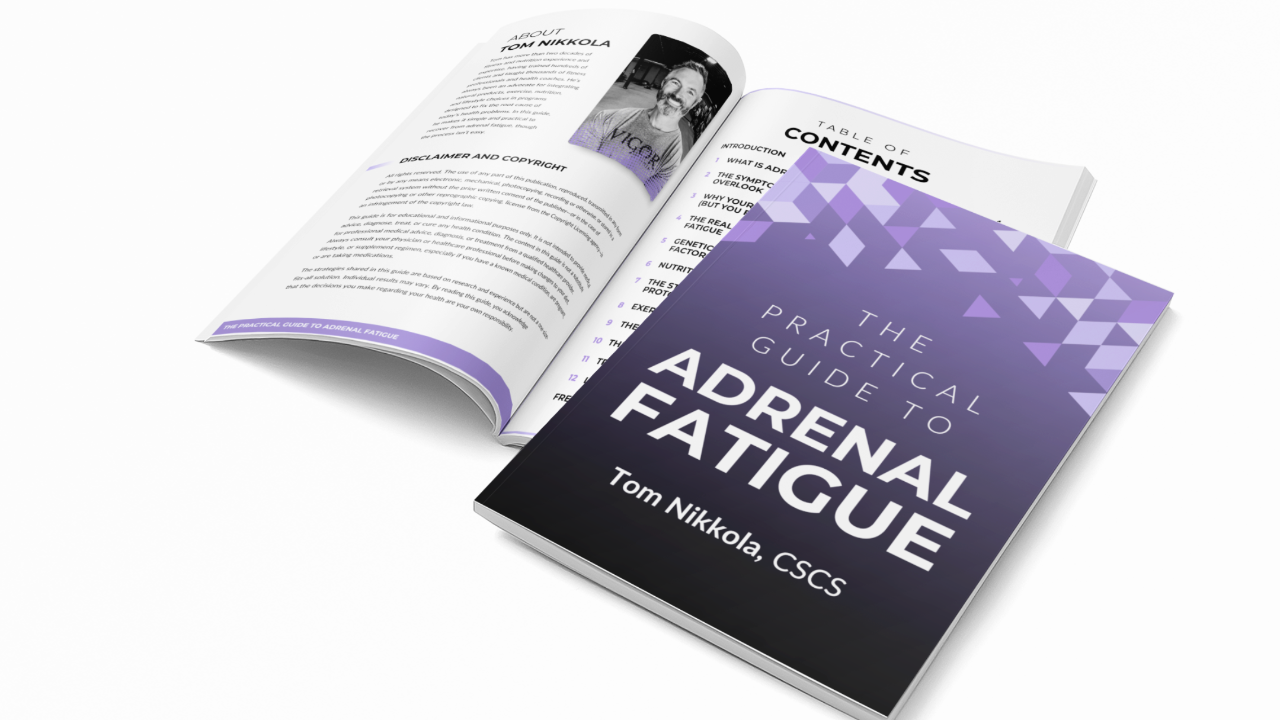
It's also why I recommend against low-carb in my Practical Guide to Adrenal Fatigue.
How low-carb turns into a gut problem, and then a histamine problem
The third thing is slower, and it's the one that catches people with mast cell or histamine issues.
The bacteria that protect your gut lining eat carbohydrate, specifically the resistant starch and fiber in potatoes, rice, squash, and fruit, and they turn it into butyrate, which is the fuel your colon cells use and the thing that keeps the gut wall sealed. Take the carbs away for long enough and those bacteria starve.
In an eight-week trial of 91 adults, the group eating four percent of their calories from carbs had fewer bowel movements, smaller stools, and less butyrate in them than the group eating the same calories with carbs in.
A gut wall with less butyrate is a leakier gut wall, and mast cells sit right in that lining, so the more that gets through, the more they have to react to. The same lining makes DAO, the enzyme that breaks down histamine, so the tissue producing your defense against histamine is the tissue you've been underfeeding.
Then there's the plate itself. A low-carb plate leans on aged cheese, cured meats, bone broth, fermented vegetables, and leftovers, which are the highest-histamine foods on any list. So the diet that lowers your histamine defenses raises your histamine load at the same meal.
I've had women come to me convinced they'd developed a dozen new food sensitivities in their second year of low-carb. Usually they hadn't developed anything. They'd starved the lining and loaded the plate, so the bucket overflowed.
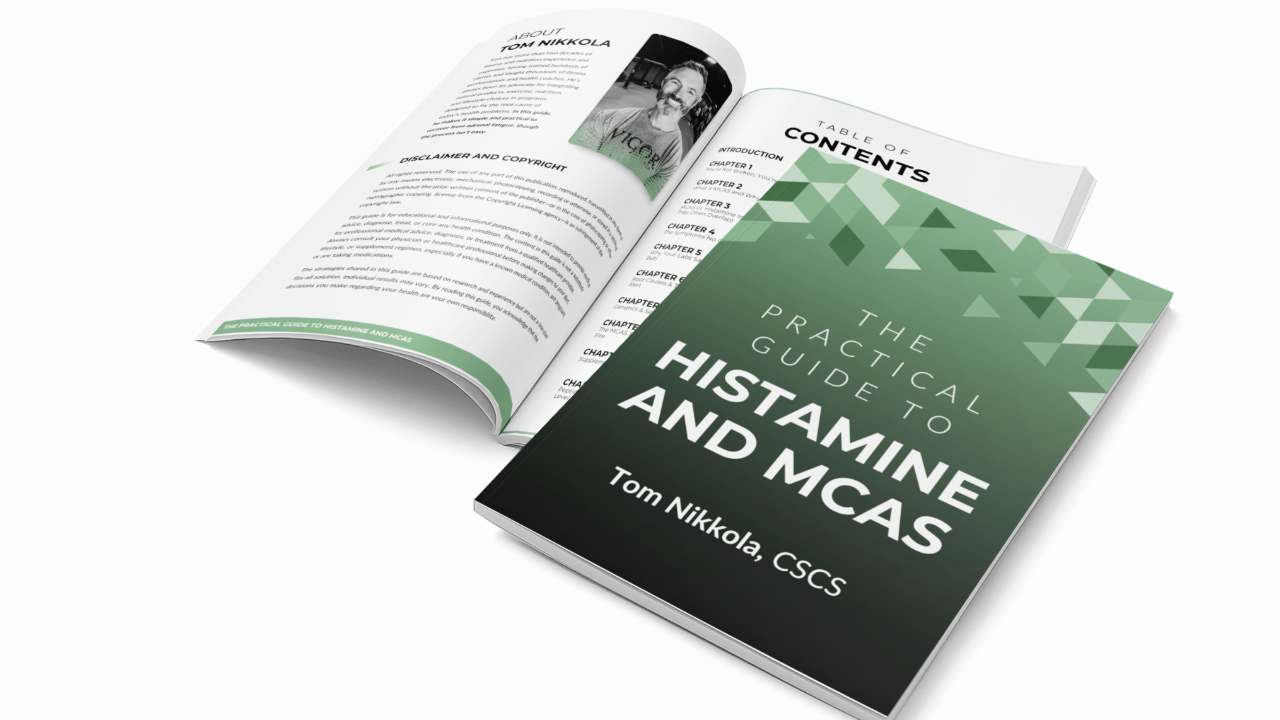
Not surprisingly, I recommend against a low-carb diet when working through my Practical Guide to Histamine and MCAS, as well.
What should you ask for?
Ask for the full panel by name: TSH, free T4, free T3, and reverse T3. If your doctor pushes back on the T3, I don't know why they would, but ask again.
Normal, optimal, and optimal for you are three different things. I like to see free T3 in the upper third of the range, somewhere around 3.2 to 4.2 pg/mL, though that's my preference from watching clients rather than a rule anyone else follows.
The two-week test
While you wait for the blood draw, you can try the experiment my client stumbled into. Eat to at least 50 grams of carbohydrate a day for two weeks, or 75-100 if you train exercise, from potatoes, rice, fruit, and squash, with protein still going first at every meal.
I'd put the carbs at dinner rather than breakfast, because sleep tends to hold better that way in the women I work with, and now you know why.
Then watch your hands at four in the afternoon. What are you looking for? You're looking for warmth, mostly, and for an afternoon that doesn't fold in half at three.
If you notice a slight improvement, bump up the carbs even a little more, while keeping your fat in check...not low-fat, just don't add extra fat like those on Instagram drinking olive oil.
I'd say one in three who try this notice something inside the first ten days. If nothing shifts by day fourteen, that's an answer too, because it points somewhere other than the carbs, usually at ferritin or cortisol, and both of those are testable.
When it's more than carbs
Sometimes the number comes back low and the two weeks change nothing. That's when thyroid medication belongs in the conversation, which I say as someone who takes it.
I've been on Armour Thyroid for fifteen years. Before it, I had the cold hands and feet and the heaviness I've been describing. Now I feel normal, which was worth a prescription.
Some people hesitate because a medication might be long term. It doesn't hurt to test how you feel, and the difference for someone who finally gets T3 can be striking.
Where the order gets individual
Here's what I can't tell you from an email. I can't tell whether your afternoons are a carb problem, a cortisol problem, a gut problem, a ferritin problem, or a conversion problem that needs a prescription, because all five look identical from the outside and the fix for one does nothing for the others.
That's what a consult is for. We look at the full panel, the ferritin, the cortisol pattern, and what you're actually eating, and we decide what to change first. Usually it's one thing.
If you know somebody who went low-carb for her energy and now describes it as stable, send her this. She'll know which word I mean.
Two next steps, depending on where you are.
If you've done the two weeks and the labs and you still can't tell whether this is carbs, cortisol, the gut, ferritin, or conversion, that's the sorting I do in a consultation. Bring the full panel. We'll decide what to change first, and it's usually one thing.
If the middle-of-the-night wake-up is your story, my Practical Guide to Adrenal Fatigue walks through rebuilding the cortisol pattern from the dinner plate up. If the food sensitivities are, the Practical Guide to Histamine and MCAS covers the gut-first sequence and the bucket, in the order I use them with clients.