Histamine intolerance and MCAS are not the same, but they live on one spectrum
Jun 12, 2026You were told it was MCAS.
So you started the protocol. Mast cell stabilizers, two antihistamines a day, a low-histamine diet you have followed so carefully that eating out now feels like a risk assessment.
And here is the part that has quietly bothered you for months. A single antihistamine and a few low-histamine days clear most of it. When you stay away from aged cheese, leftovers, wine, and cured meat, you feel close to normal. That is not how severe mast cell disease usually behaves.
If the simple version of the plan works that well, you may be further toward the histamine end of this than the label suggests.
Because these two are not two separate boxes. They are two ends of one spectrum. At one end, your enzymes cannot clear histamine fast enough. At the other, your mast cells themselves are firing too easily. Many people sit somewhere in between, and plenty start near the histamine end and drift toward the mast cell end over time.
The label matters less than knowing where you sit, because that is what decides how to weight the plan. Let me give you the mechanism at each end, the four signals that locate you on the spectrum, and how the plan shifts depending on where you land.
The histamine end: a clearance problem
Histamine intolerance is a clearance problem. You take in histamine, and from food and your own gut bacteria, and your body cannot break it down fast enough to keep up.
Two enzymes do that breakdown. Diamine oxidase, or DAO, sits in the lining of your small intestine and degrades histamine in the gut before it reaches your bloodstream. Histamine N-methyltransferase, or HNMT, works inside your cells and clears histamine through methylation.
When either enzyme cannot keep up, histamine spills past the point where you can handle it. Researchers describe this as a histamine "overflow," and the symptoms appear soon after a histamine-heavy meal: flushing, headache, loose stools, a racing heart, congestion, hives.
Two details matter here. DAO is made by the cells lining your upper gut, so when that lining is inflamed or damaged, your DAO drops with it. And HNMT depends on methylation, which is why the same MTHFR and methylation issues you may already be managing can quietly reduce your ability to clear histamine.
This is a supply-and-demand problem. The demand is the histamine load. The supply is your enzyme capacity. Lower the load or raise the enzymes, and the picture calms down.
The mast cell end: a threshold problem
Mast cell activation syndrome sits at the other end. The issue is not a missing enzyme. The issue is a cell with the trigger set too low.
Mast cells are immune cells that store inflammatory chemicals and release them when they sense a threat. In MCAS, they fire too easily and too often, and when they do, they release far more than histamine. They release tryptase, prostaglandins, leukotrienes, and a long list of other mediators all at once.
That is why MCAS rarely stays in one lane. The consensus diagnostic criteria ask for episodic symptoms across two or more organ systems, a measurable rise in tryptase during an episode (at least 20 percent above your own baseline, plus 2 ng/mL), and a response to drugs that block mast cell mediators.
So histamine is one actor in MCAS, not the whole cast. That single fact explains why a low-histamine diet helps the people further along the spectrum only partway, and why an antihistamine that targets one receptor leaves so much of the reaction untouched.
At one end the enzyme is falling behind. At the other the cell is firing too easily. Same molecule the whole way along, and the two ends shade into each other in the middle.
The four signals that locate you on the spectrum
You do not need a perfect lab workup to find your place. Four patterns do most of the work, and each one is less a yes-or-no than a slider.
- How well antihistamines and a low-histamine diet work. If one antihistamine and a lower-histamine week clear most of your symptoms, you are near the histamine end. If you stack stabilizers and two antihistamines and still react, you have moved toward the mast cell end.
- What sets you off. Near the histamine end, reactions track food. They follow aged, fermented, leftover, and alcoholic foods, and they scale with the dose. Further along, you react to things that are not food at all: heat, cold, exercise, friction on the skin, fragrance, stress, hormonal shifts.
- How many systems light up. Near the histamine end, symptoms cluster in the gut, the head, and the skin, usually after meals. Further along, the cardiovascular and respiratory systems join in, with tachycardia, near-fainting, wheezing, and throat tightness showing up in the same episode.
- Which direction it is heading. This is the one that tells you about movement. Histamine overflow behaves like a bucket, filling with load and emptying when you back off, with a fairly steady threshold. The further you drift toward the mast cell end, the more it escalates and generalizes, with new triggers appearing and reactions widening over months.
One clean read: food-driven, dose-dependent, antihistamine-responsive, and stable means you are near the histamine end. Multisystem, non-food triggers, and escalating means you have moved toward the mast cell end. Most people are not purely one or the other, and that is the point.
Everyone starts in the same place
This is the part that surprises people. Wherever you sit on the spectrum, the first month of care is nearly identical, and it should be.
You lower the histamine load with a calmer diet, you remove the obvious triggers, and you support the system with the same basics. A low-histamine eating pattern, DAO with meals, vitamin C, B6, magnesium, and quercetin make up the shared foundation at every point on the spectrum.
So far, so good. Most people feel better. And this is where the misread happens, because feeling better in month one does not tell you where you sit. It only tells you the foundation was the right place to begin.
What you do next is where your position on the spectrum starts to matter.
After the foundation, you weight the plan
It is one plan, not two. After the first month, you keep the foundation and lean harder on the part that matches where you sit. The closer you are to the histamine end, the more you weight toward the enzymes. The closer you are to the mast cell end, the more you weight toward the cell and the load behind it.
Closer to the histamine end, lean into enzyme support and dietary calibration.
- Keep DAO with meals, since it degrades food histamine in the gut before it reaches your blood. Take it shortly before you eat, not after.
- Feed the enzymes their cofactors. DAO is a copper-dependent enzyme that needs vitamin B6 to function, and vitamin C supports histamine breakdown. HNMT depends on methylation, so your folate and B12 status matters here too.
- Repair the gut lining. Because DAO is made by the cells of your upper intestine, healing that lining is how you raise your own enzyme over time, which is the real goal.
- Then calibrate the diet back up. The low-histamine phase is a tool, not a life sentence. You reintroduce foods deliberately to find your threshold, so you eat the widest diet your enzymes can handle.
⠀Closer to the mast cell end, lean into stabilizing the cell and lowering its load.
- Stay on the stabilizers, and give them more weight. Quercetin inhibits histamine release from human mast cells and basophils, and in a human study it outperformed cromolyn at blocking mast cell mediator release. Luteolin pairs well with it.
- Widen the trigger search past food. Heat, friction, fragrance, stress, and hormonal timing often matter more than the menu at this end.
- Look upstream for what is keeping the cells primed: a chronic infection, mold exposure, or a nervous system stuck in a high-alert state. Lowering that background load is what raises your threshold, and it is most of the work the further along you are.
The two ends are not separate roads. They are the same road, walked with the weight shifted toward wherever your body actually is. And because the far end pulls in real medical territory, if you are reacting across many systems, that is the point to bring a physician into the plan rather than managing it alone.
Why a single label keeps you stuck
The trouble starts when one label freezes you at the wrong point on the spectrum.
Pinned at the mast cell end when you are really near the histamine end, you stay on stabilizers and a permanently restricted diet, you never rebuild DAO, and you never find your threshold. You stay smaller and more limited than your physiology actually requires, indefinitely.
Pinned at the histamine end when you have drifted toward the mast cell end, you white-knuckle a low-histamine diet that keeps half-failing, because the reactions are now coming from heat and stress and fragrance that no diet will fix. Month after month, you conclude you are not disciplined enough, when the real issue is that the plan was weighted to the wrong end.
Both people are doing the work. Both are following a plan. The plan is just weighted to the wrong place on the spectrum, and effort cannot make up for that.
The label is not the point. Where you sit is, and it can move, which is why the plan has to move with it.
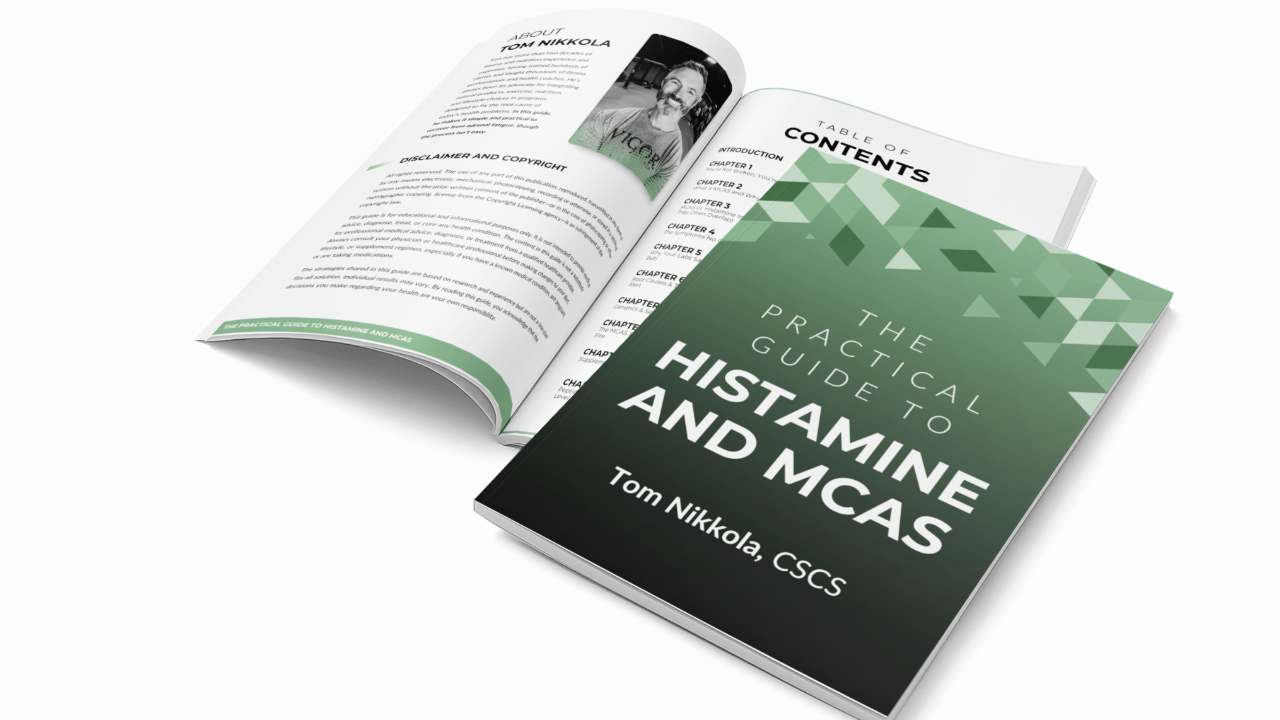
The Practical Guide to Histamine and MCAS
If you have read this far and you are still not sure where you sit on this spectrum, that uncertainty is the exact problem the guide was built to solve.
It gives the distinction its own chapter, includes a self-assessment to place where you sit on the spectrum, and lays out the starting protocol with the actual supplement forms and doses. It also walks the food reintroduction method, so you find your threshold instead of restricting forever, and the root causes that keep mast cells primed in the first place. You will know which side you are on and what to do about it.
Tap here to get The Practical Guide to Histamine and MCAS for $20 off!
If you want the DAO, quercetin, and cofactor products from this piece in one place, they are in my Fullscript dispensary at professional grade and third-party tested. Tap here to access my dispensary.
If you want personalized support
If your picture is tangled, and many are, with hormones, gut history, and methylation all in the mix, a one-on-one consultation is the fastest way to locate where you sit on the spectrum and weight the plan around your actual physiology.
The molecule is the same the whole way along. Where you sit on the spectrum is what changes. Find your place, weight the plan to it, and the reactions finally have somewhere to go.