Are Microplastics Really That Bad, or Is it Influencer Fear-Mongering?
Mar 03, 2026You've seen the headlines.
Microplastics found in brain tissue. In testicles. In placentas. In blood. In the lungs of people who never worked in a factory.
Cue the spiral.
If you're already managing histamine issues, estrogen dominance, mast cell reactivity, or a thyroid that moves at the speed of a DMV line, reading that plastic is literally inside your endocrine tissue is not exactly comforting.
Here's the thing though: the science on microplastics is real. The concern is legitimate.
But the way it's being covered isn't helping you.
Most of it is either full-alarm mode with no actionable guidance, or vague "reduce your plastic exposure" advice that doesn't account for the actual physiology.
So let's talk about what's actually happening, and what it means for you specifically.
What Microplastics Are Actually Doing Inside You
Microplastics aren't just floating around harmlessly. The concern is about their chemical load and how they interact with your biology at the receptor level.
The most well-documented mechanism is endocrine disruption. Many plastics carry compounds that behave like estrogen in your body. They bind to estrogen receptors without actually being estrogen, which confuses your signaling without triggering the normal clearance process. Your body doesn't know it's been fooled.
The main offenders:
- BPA (bisphenol-A): found in hard plastics, can linings, and thermal receipt paper
- Phthalates: used to make plastic flexible; common in packaging, tubing, and personal care products
- PFAS ("forever chemicals"): in nonstick cookware, water-resistant coatings, food packaging
Think of it like a key that fits the lock but doesn't turn it cleanly. The door opens partway, something misfires, and now the whole feedback loop is off.
This matters most if you're already dealing with:
- Estrogen dominance or PMS
- Heavy or irregular periods
- Mood swings around ovulation
- Perimenopausal symptoms that don't respond to basic interventions
If estrogen clearance is already sluggish, due to COMT or MTHFR variants, poor gut health, or a congested liver, adding more estrogenic compounds to the mix is throwing fuel on a fire that was already burning.
The Histamine and Mast Cell Connection No One's Talking About
This is the part that doesn't get covered in mainstream health content, and it should.
Several plastic-associated compounds, particularly phthalates and BPA, appear to lower the threshold for mast cell activation. In people who are already mast cell-reactive, whether from MCAS, histamine intolerance, or chronic immune sensitization, this is significant.
Mast cells are part of your immune surveillance system. They sit in your gut lining, your skin, your airways, and your connective tissue.
When triggered, they release histamine along with a cascade of inflammatory mediators. In a healthy system, they respond to genuine threats and quiet down. In a sensitized system, they're already running hot, and chemical exposures like microplastic-associated compounds lower the activation threshold even further.
Translation: If you already react to foods, scents, stress, heat, or seemingly nothing at all, microplastic exposure isn't creating a new problem from scratch. It's lowering your buffer even more.
Common signs your mast cells are already sensitized:
- Reactions to foods that didn't bother you before
- Flushing, itching, or hives without an obvious trigger
- Fatigue or brain fog after eating fermented foods, leftovers, or alcohol
- Heightened sensitivity to fragrances, cleaning products, or environmental chemicals
- Feeling worse during high-pollen seasons or in moldy environments
There's also emerging evidence that some of these compounds interfere with diamine oxidase (DAO), the primary enzyme responsible for breaking down histamine in the gut. Less DAO activity means histamine accumulates more easily, which is bad news if you're already eating fermented foods, leftovers, or wine and wondering why you feel terrible afterward.
Body Burden: The Concept That Changes How You Think About This
Here's the mental model that actually helps.
"Body burden" refers to the total accumulated load of environmental toxins your body is carrying at any given time. Think of it like a bucket. Every exposure adds to the bucket:
- Pesticide residues in food
- Synthetic fragrances in products
- Heavy metals in water or cookware
- Alcohol and processed food
- Mold and mycotoxins
- And yes, microplastics
Your body has clearance systems, methylation, liver detox pathways, kidney filtration, gut elimination, lymphatic drainage. When the bucket is manageable, these systems keep up.
When the bucket overflows, that's when symptoms emerge.
This is why two people can have the same microplastic exposure and have completely different outcomes. One person has robust methylation, a healthy gut, and good stress regulation. Their bucket has plenty of room. The other person has a sluggish COMT variant, a dysbiotic gut, chronically elevated cortisol, and borderline ferritin. Their bucket was already almost full.
Microplastics don't cause disease in a vacuum. They add to an existing load. And if your load was already high, even a modest additional stressor pushes things over the edge.
What's Worth Prioritizing (And What's Theater)
The microplastics conversation tends to trigger a specific kind of health anxiety spiral, one where people start obsessing over glass versus plastic water bottles while continuing to eat ultra-processed food, stay up until midnight, and skip meals.
That's not a judgment. It's just worth naming.
Reducing plastic exposure does matter. But before you spend mental energy on it, make sure your elimination is actually working, because all the reduced exposure in the world doesn't help if your body can't clear what it's already carrying.
Here's the order that makes sense physiologically:
1. Support your clearance pathways first. If methylation is impaired (MTHFR, COMT), your liver's phase II detox slows down. Estrogens, environmental chemicals, and plastic metabolites don't clear efficiently. This is where the real leverage is. Start with following your pattern specific protocol in my new MTHFR guide!
2. Get your gut working. DAO activity depends on a healthy intestinal lining. SIBO, leaky gut, and dysbiosis all reduce your capacity to break down histamine and process dietary and environmental exposures. Fix the gut and you raise your tolerance threshold significantly.
3. Reduce high-exposure sources, strategically. Not all plastic exposure is equal. Heating food in plastic containers, using nonstick cookware, drinking out of soft plastic bottles left in a hot car, and eating processed foods wrapped in plastic film are the highest-yield areas to address. These aren't hard swaps.
4. Manage your bucket load systemically. Chronic stress, poor sleep, and alcohol all compete for the same clearance pathways as environmental toxins. Reducing these gives your body more capacity to handle exposures it can't avoid.
The Practical Swaps That Actually Matter
If you want to reduce your plastic exposure in a meaningful, non-obsessive way, focus here:
- Glass or stainless steel for hot liquids. Heat accelerates the leaching of plastic compounds. Cold water in a plastic bottle is lower risk than hot coffee or tea in one.
- Never microwave in plastic. This one's a high-exposure situation and an easy fix.
- Filter your drinking water. Microplastics are present in tap water. A high-quality carbon block or reverse osmosis filter reduces this significantly.
- Minimize ultra-processed food. Not because of the food itself, though that matters too, but because heavily processed and packaged food has more contact with plastic packaging and often contains plastic-associated compounds from the manufacturing process.
- Skip the fragranced everything. Synthetic fragrances are phthalate delivery systems. This includes fabric softener, dryer sheets, air fresheners, and heavily scented personal care products. Your mast cells will thank you.
Where to Start If You Know You're Already Reactive
If you're reading this and you already deal with histamine issues, MCAS, hormone imbalances, or know you have MTHFR or COMT variants, the microplastics conversation isn't meant to add to your stress. It's meant to give you a better map.
Understanding the mechanisms helps you make smarter decisions rather than reactive ones. You're not powerless here. You're working with a body that has a smaller margin for error, which means you prioritize the fundamentals harder, not that you're doomed.
The fundamentals are still the fundamentals:
- Methylation support
- Gut integrity
- Liver function
- Sleep and stress regulation
- Adequate protein
These aren't wellness buzzwords. They're the actual infrastructure your body uses to process and eliminate everything it encounters, microplastics included.
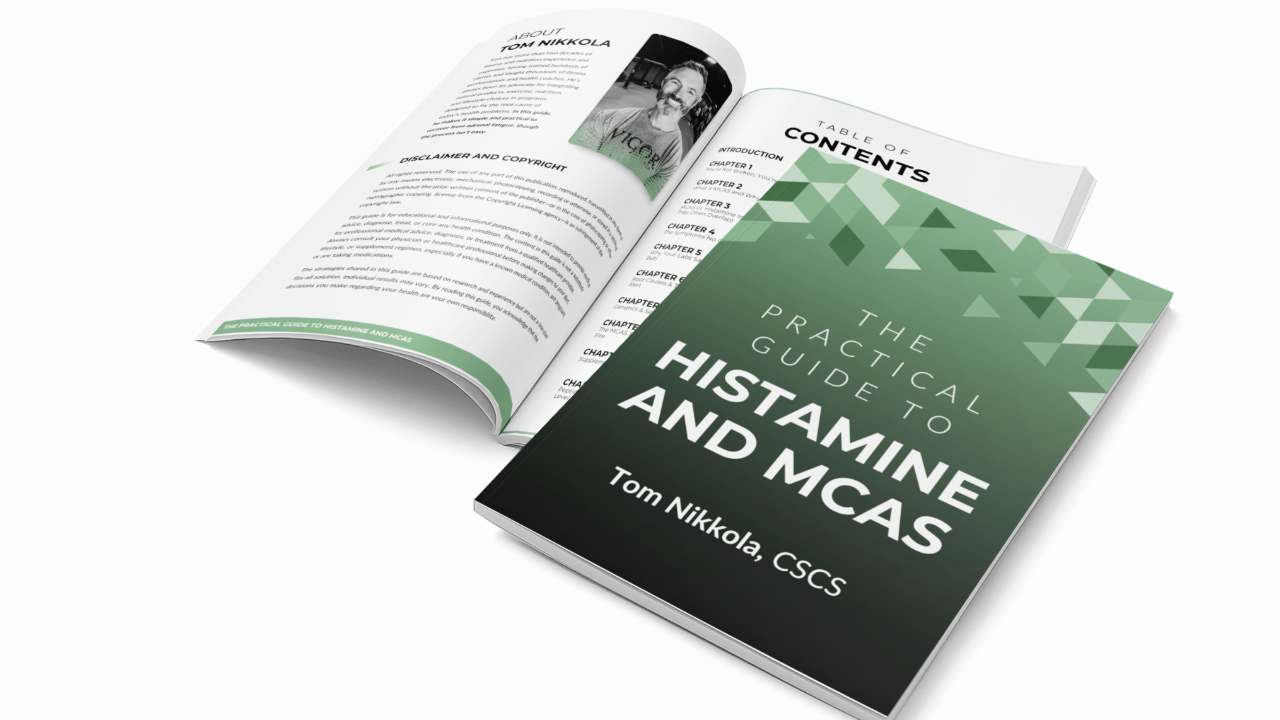
If you want a deeper look at how your genetics might be affecting your clearance capacity, the MTHFR Guide and COMT Guide are both worth working through. And if histamine reactivity or mast cell patterns are part of your picture, the Histamine & MCAS Guide covers the physiology and the practical steps in detail.
The microplastics problem is real. The alarm is understandable. But the path forward isn't panic. It's understanding your own bucket, addressing what's actually filling it fastest, and making the swaps that give your body a fighting chance at clearing the rest.
You can't avoid all of it. Nobody can. But you can make your clearance systems more capable. That's where this is worth your energy.