
Awareness of MCAS has exploded over the past year, but most doctors are still unware of it. That leaves a lot of patients who go through converntional medicine feeling frustrated. And rightly so.
If you have mast cell activation syndrome, you know how frustrating it feels day to day, wondering if the next scent, food, or personal care product you use will send you into a full-blown flare.
When you're dealing with the symptoms, you want a diagnosis. That's the pattern we're used to with modern medicine.
And in many cases, a diagnosis depends on lab tests.
Here's where things get confusing. Although there are some lab markers that can suggest MCAS, MCAS is rarely identifed based on lab markers.
So, if you’ve tried to “get tested” for MCAS… and came back with nothing, you’re not alone.
Here’s the clarity most people don’t get from their doctor.
Mast Cell Activation Syndrome (MCAS) is when your mast cells release too many chemical “alarms” (histamine is just one of them), too often, and in the wrong situations.
Mast cells are supposed to protect you. They help you respond to infections, toxins, injury, and allergens.
But when they get overactive, they start acting like a smoke alarm that goes off when you make toast.
And the hard part is this: MCAS usually doesn’t show up on lab tests. It shows up as a pattern.
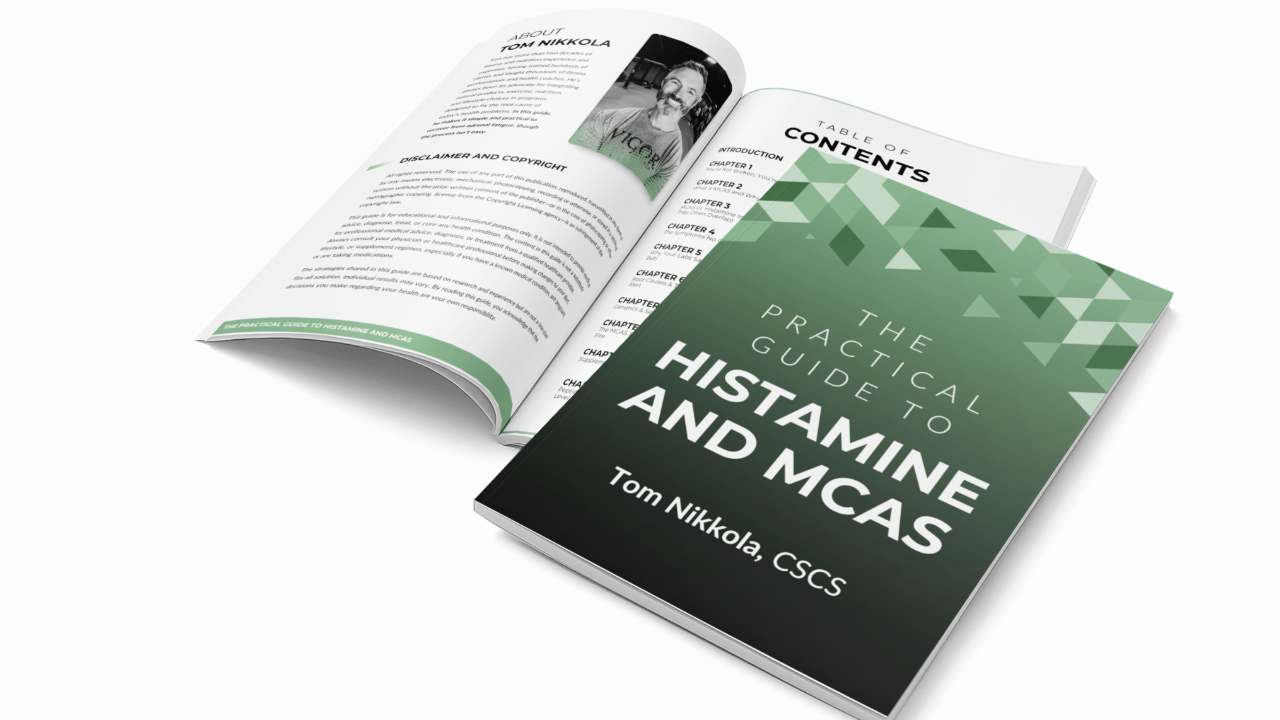
[By the way, if you know you have MCAS and need the right plan to minimize its effect in your life, get my Practical Guide to Histamine and MCAS. It's the fastest way to start feeling normal again!]
Here’s what’s actually happening
Most people assume diagnosis works like this:
Symptom → test → diagnosis → treatment.
That’s how true diseases often work. You can “see” diabetes in an A1c. You can “see” hypothyroidism in TSH (most of the time). You can “see” anemia in hemoglobin.
MCAS doesn’t behave like that.
Because the chemicals mast cells release spike… then disappear.
That’s the single reason testing is so inconsistent.
If you’re not catching the spike at the right moment, the test looks normal. And many people get tested on a random Tuesday at 10:00 a.m. when they’re having a decent day.
Meanwhile, their worst flare was last Thursday night after:
-
a stressful day
-
leftover food
-
a hot shower
-
wine (or even just vinegar)
-
a brutal workout
-
their luteal phase
-
a new supplement
-
mold exposure
-
a cold virus
The “event” is real. But by the time you draw blood or collect a sample, the chemical evidence is gone.
Why the labs miss it (even when MCAS is real)
A few common mediator tests get discussed in the MCAS world:
-
Serum tryptase
-
Urinary N-methylhistamine
-
Urinary prostaglandin metabolites
-
Urinary leukotriene metabolites
Those can help sometimes.
But in the real world, results are all over the place because:
-
Timing matters.
Many mediators rise quickly and fall quickly. Miss the window, miss the signal. -
Handling matters.
Some markers degrade easily. If collection and storage aren’t done correctly, results can be falsely low. -
Triggers vary.
One person’s mast cells react to heat and stress. Another reacts to food changes. Another reacts to hormones. So one “test day” may not represent their real problem. -
MCAS isn’t one uniform condition.
It’s an umbrella for patterns of inappropriate activation. People can have different dominant mediators, different triggers, and different symptom clusters.
So yes, testing exists. But for most people, it becomes a frustrating money pit.
And that brings us to the part that changes everything.
If you remember nothing else from this email…
Here’s why this matters for your body: MCAS is often identified by patterns and response, not by a single lab.
That’s why people can spend years chasing the “right test” while their life keeps shrinking.
Because what they actually needed was a smarter way to recognize the pattern… and start stabilizing the system that’s keeping mast cells on edge.
Why MCAS is called a syndrome (and why that changes diagnosis)
MCAS is labeled a syndrome for a reason.
A disease usually implies a single dominant cause and a direct standard treatment. A syndrome implies a recognizable cluster of symptoms that can come from multiple drivers.
That’s why the medical system struggles with it.
There’s no one drug that “fixes MCAS.” There’s no one lab that proves it beyond doubt in typical clinic conditions.
Instead, the clinical reality is often:
-
multiple body systems involved
-
symptoms that change week to week
-
reactions that feel random but follow hidden triggers
-
partial relief from antihistamines or mast cell stabilizing strategies
-
flares during stress, sleep loss, hormone shifts, heat, illness, or gut disruption
So the “diagnosis” often becomes less about a stamp on paper… and more about recognizing what’s happening and responding appropriately.
The symptom patterns that should make you think “mast cells”
Not everyone with these symptoms has MCAS. But if you see clusters across systems, especially if they’re reactive and unpredictable, mast cells deserve a serious look.
Skin / allergy-type patterns
-
flushing, itching, hives, dermatographia (skin writing)
-
random rashes that come and go
-
swelling or puffiness without a clear cause
-
reactions to fragrances, detergents, temperature changes
Gut patterns
-
bloating that changes day to day
-
diarrhea, urgency, cramping, nausea
-
“I react to foods that never bothered me before”
-
intolerance to leftovers, fermented foods, vinegar, alcohol
Nervous system / brain patterns
-
anxiety that feels chemical, not situational
-
insomnia, wired-but-tired
-
brain fog, derealization, adrenaline surges
-
sensitivity to supplements and meds (especially “stimulating” ones)
Cardiovascular / breathing patterns
-
racing heart, palpitations, lightheadedness
-
air hunger, chest tightness
-
symptoms that overlap with POTS (and often coexist)
And one of the biggest giveaways:
Your symptoms don’t stay in one lane.
They migrate.
One week it’s mostly gut.
Next week it’s mostly skin.
Then it’s insomnia and anxiety.
Then it’s all of it at once after a stressful event.
That’s classic mast cell behavior.
How MCAS is often identified in practice
In the real world, MCAS is often recognized through three things:
-
Multi-system symptoms that come in flares
Not one symptom. A pattern. -
Clear triggers
Heat, stress, hormones, infections, certain foods, alcohol, sleep loss, intense exercise, mold, fragrance, pick your poison. -
Response to stabilization
This matters more than people realize.
When someone starts supporting the nervous system, reducing inflammatory load, improving gut stability, and using targeted tools (often including antihistamine strategies and mast cell support), and they improve… that response is information.
It’s not “placebo.”
It’s physiology.
What to do instead (without turning your life into a bubble)
I don’t want you spiraling into a 40-supplement protocol or a diet that makes you afraid of food.
Start with principles that calm the system.
Here are a few that consistently matter:
1) Stabilize your nervous system before you chase triggers.
If your stress response is stuck “on,” mast cells stay easier to activate. Sleep, light exposure, breath work, and pacing are not fluffy, they’re foundational.
2) Make your food more predictable for 2–3 weeks.
Not perfect. Predictable. Simpler meals, fresh protein, fewer histamine landmines, less alcohol, fewer leftovers. This isn’t forever. It’s a stabilizing phase.
3) Train in a way that builds resilience, not flares.
Many MCAS bodies react badly to “go hard” workouts. But they often do great with strength training that’s submaximal, controlled, and consistent, because it teaches your system that stress can be safe.
4) Use targeted support, not random stacks.
This is where people waste months. They buy ten supplements, react to three, and conclude “nothing works for me.”
There’s a smarter order of operations, especially when you factor in the gut, minerals/electrolytes, nutrient status, and (in some cases) peptides.
A quick note on “getting diagnosed”
If you want the medical route, an allergist/immunologist is usually the starting point. Just go in with realistic expectations:
-
you may not get a definitive lab confirmation
-
you may need to test during a flare (and handle samples correctly)
-
you may be told “it’s not MCAS” simply because a number didn’t spike that day
That doesn’t mean you’re fine. It means the condition doesn’t behave like a simple lab diagnosis.
And if you suspect MCAS, you don’t need to wait for perfect testing to start stabilizing your body.
If you want the full plan
This is exactly why I created my Histamine & MCAS Guide.
Not to convince you with theory, but to give you a step-by-step way to calm mast cells and widen your tolerance again using:
-
nutrition that stabilizes without making you afraid of food
-
lifestyle and nervous system support that actually moves the needle
-
training that builds resilience (without flaring you)
-
supplement strategy that’s ordered and logical
-
and, when appropriate, peptide support as a tool—not a miracle
If MCAS has been confusing, this guide will make it feel organized.
If this email hit close to home, hit reply and tell me: what symptom pattern feels most “you” right now?



Responses