
If you feel like every woman you know either has PCOS, thinks she has PCOS, or is dealing with a mystery collection of symptoms no one can explain…you're not imagining it.
Twenty years ago, PCOS was considered rare.
Today? Depending on the study you read, it affects 1 in 5 women of reproductive age, and based on what I see in my coaching program, that number is probably still an underestimate.
And the most heartbreaking part?
Most women don’t get answers.
Most women get dismissed.
Most women get told it’s “just stress,” “just age,” or “just lose weight and come back later.”
Maybe that’s been your story, too.
You go in with symptoms that are very real...bloating, heavy cycles, missing cycles, stubborn weight gain, cystic acne, thinning hair, irritability, brain fog, exhaustion that comes out of nowhere...and you leave feeling more confused than when you walked in.
Or maybe it’s your daughter. Or your sister.
And you’re watching her struggle, knowing something isn’t right, but no one’s connecting the dots.
So what changed?
Why has PCOS exploded over the past two decades?
And why are so many women treated the same way even though PCOS has four different root causes, not just one?
Let’s break this down clearly, simply, and truthfully, while giving you hope that PCOS absolutely can be reversed when you understand what’s actually driving it.
The First Truth: PCOS Isn't a "Hormone Problem," It's a System Problem
If there’s one thing I wish every woman knew, it’s this:
PCOS isn’t a single condition. It’s a metabolic, inflammatory, and neuroendocrine disorder that happens to show up in your reproductive system.
Hormones are the symptom, not the cause.
When you zoom out, PCOS has its fingerprints in:
-
Blood sugar regulation
-
Gut health
-
Inflammation
-
Sleep and circadian rhythm
-
Stress and cortisol
-
Immune system
-
Environmental toxin load
This is why PCOS looks different in every woman.
It’s why your friend’s PCOS doesn’t look like yours.
It’s why your sister may have acne and irregular cycles while you struggle more with weight, anxiety, or inflammation.
It’s also why the old-school approach...birth control + metformin...rarely works long-term.
Because you can’t fix a whole system with two band-aids.
So Why Are PCOS Rates Skyrocketing?
There are five major reasons, and when you understand them, PCOS suddenly makes sense.
1. We’re more insulin resistant than ever.
This is the big one, and the research is very clear. Women today are more insulin resistant at younger ages than any generation before them. Ultra-processed foods, chronic snacking, low-protein diets, poor sleep, and nonstop stress all contribute.
High insulin triggers the ovaries to produce more testosterone.
More testosterone disrupts ovulation.
Disrupted ovulation leads to the chaotic cycles, acne, hair issues, and infertility PCOS is known for.
And here’s the kicker: You can be lean and still insulin resistant. This is why so many women get dismissed.
2. Chronic stress is at an all-time high.
Women today carry more emotional, mental, and physiological stress than previous generations:
-
Parenting
-
Work
-
Caregiving
-
Sleep deprivation
-
Trauma
-
Overtraining
-
Undereating
-
High expectations and low recovery
Chronically elevated cortisol drives a form of PCOS called Adrenal PCOS, where the adrenal glands, not the ovaries, produce excess androgens.
This is why many women feel “wired but tired,” anxious, inflamed, and overwhelmed.
3. Environmental toxins have become impossible to avoid.
Twenty years ago, we weren’t bathing in endocrine disruptors like we are now.
Today, women are exposed to:
-
BPA
-
Phthalates
-
PFAS
-
Pesticides
-
Microplastics
-
Fragrances
-
Industrial chemicals
These compounds interfere with the gut, thyroid, liver, and ovaries. They mimic estrogen, disrupt detox pathways, and increase inflammation, all major PCOS triggers.
4. Gut dysfunction has become the norm, not the exception.
The research on the gut-brain-ovary axis has changed everything.
Women with PCOS have:
-
Lower bacterial diversity
-
More inflammatory bacteria
-
Increased intestinal permeability
-
Altered bile acid metabolism
This increases inflammation, disrupts hormone balance, raises androgens, and makes insulin resistance worse.
It’s a perfect storm inside the gut that spills over into the ovaries.
5. Birth control rewires hormone signaling long after you stop it.
This isn’t anti–birth control. It’s pro–informed consent.
Many women develop PCOS symptoms after coming off birth control because their brain-ovary communication was suppressed for years. Some women recover quickly, but many don’t without support.
This leads to Post-Pill PCOS, one of the four major types.
The Second Truth: There Isn't Just One PCOS, There are Four
Here’s one of the biggest reasons women stay stuck:
PCOS has four types, and each one requires a completely different strategy.
Most women fall into one (or more) of these:
1. Insulin-Resistant PCOS
The most common type and the most reversible. Triggered by high insulin.
2. Adrenal PCOS
Driven by stress, trauma, undereating, or overtraining. Shows up with elevated DHEA-S.
3. Post-Pill PCOS
Emerges after stopping hormonal birth control.
4. Inflammatory PCOS
Linked to gut issues, immune dysfunction, toxins, or chronic inflammation.
No wonder generic protocols don’t work.
Imagine trying to fix a flat tire by replacing the windshield.
Once women learn their type, everything makes sense.
Their symptoms stop feeling random.
Their body stops being a mystery.
Their healing finally becomes predictable.
The Third Truth: Most Women Aren't Misdiagnosed, They're Under-Diagnosed
Most women with PCOS aren’t diagnosed for 5–12 years.
Why?
Because the diagnostic criteria haven’t caught up with the science.
Doctors are trained to look for:
-
Irregular periods
-
High testosterone
-
Polycystic ovaries
But here’s what women with PCOS often have instead:
-
Normal cycles
-
Normal weight
-
Normal labs
-
No visible cysts
Yet they’re dealing with:
-
Chronic bloating
-
Anxiety
-
Mood swings
-
Fatigue
-
Hair thinning
-
Sugar crashes
-
Heavy periods
-
Acne
-
Infertility
-
Joint pain
-
Histamine symptoms
Not one of these symptoms shows up on a standard PCOS diagnostic chart—yet they are absolutely part of the PCOS picture.
If PCOS is Reversible, Why Doesn't Anyone Say That?
Because most systems treat the symptoms, not the root.
Birth control forces a fake cycle. Metformin addresses part of the problem. Spironolactone manages acne. Antidepressants dull the emotional fallout.
But none of these fix:
-
Insulin resistance
-
Inflammation
-
Gut dysfunction
-
Nervous system dysregulation
-
Environmental triggers
You can’t out-medicate a root cause problem.
But when you address the root, the body responds fast:
-
Cycles return
-
Energy stabilizes
-
Bloating disappears
-
Mood lifts
-
Hair stops shedding
-
Fat loss becomes easier
-
Ovulation improves
-
Confidence comes back
I’ve seen this over and over again.
Why I Created my PCOS Guide (and Why It's Resonating So Deeply
Women told me they were tired of:
-
Generic advice
-
Being dismissed
-
One-size-fits-all diets
-
“Just lose weight” comments
-
Being told their labs were “normal”
-
Feeling like a stranger in their own body
So I created The Practical Guide to PCOS—a 160+ page resource that finally brings clarity to what women have not been told:
-
What PCOS actually is
-
Why your symptoms don’t look like anyone else’s
-
The 4 types of PCOS and how to identify yours
-
Step-by-step plans for each type
-
The metabolic, nervous system, gut, and hormonal layers
-
How to support your body naturally
-
What labs to run
-
How to reverse the root causes
It’s the guide I wish every woman had at 16, 26, or 46.
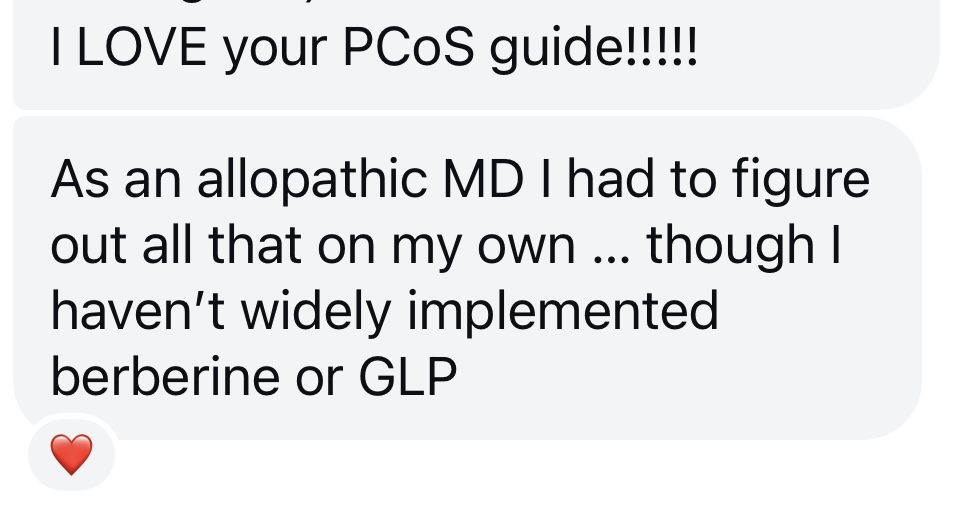
Tap here to get my Practical Guide to PCOS for $20 off!
If you take nothing else from this, please understand:
PCOS can be reversed.
Your metabolism can recover.
Your hormones can rebalance.
Your cycle can normalize.
Your energy can come back.
You can feel like yourself again.
And you do not have to figure it out alone.
My guide will walk you through everythihng you need to know!



Responses